


How, When and Why You Should Change Your Axolotl's Water


If axolotls could talk, one of their favourite phrases would probably be:
"Can I have some fresh water, please?"
Unlike dogs that need walks or cats that demand dinner at 5:01 pm, axolotls rely on something much simpler to stay healthy:
Clean, stable water.
In fact, water quality is one of the most important factors in axolotl care. The cleanest tank decorations, the fanciest filter, and the most expensive food won't help much if the water itself isn't healthy.
The good news?
Water changes are easy once you understand why they matter.
Let's dive in.
Why Do Axolotls Need Water Changes?
Your axolotl is constantly producing waste.
Every meal they eat eventually becomes poop, and every poop contributes waste products to the aquarium.
Even in a fully cycled tank, these waste products don't disappear completely.
Beneficial bacteria convert harmful ammonia into nitrite and then nitrate, but nitrate continues to build up over time.
Think of your aquarium like a bathtub.
Even if the water looks clean, you wouldn't want to sit in the same bathwater for weeks.
Water changes remove waste, dilute nitrates, replace important minerals, and keep your axolotl living in fresh, healthy conditions.
What Happens If You Don't Change the Water?
Poor water quality can lead to:
• Stress
• Reduced appetite
• Curled gills
• Forward-facing gills
• Reduced growth
• Increased risk of illness
• Poor healing
• Shortened lifespan
Often the water can appear crystal clear while harmful substances are building up.
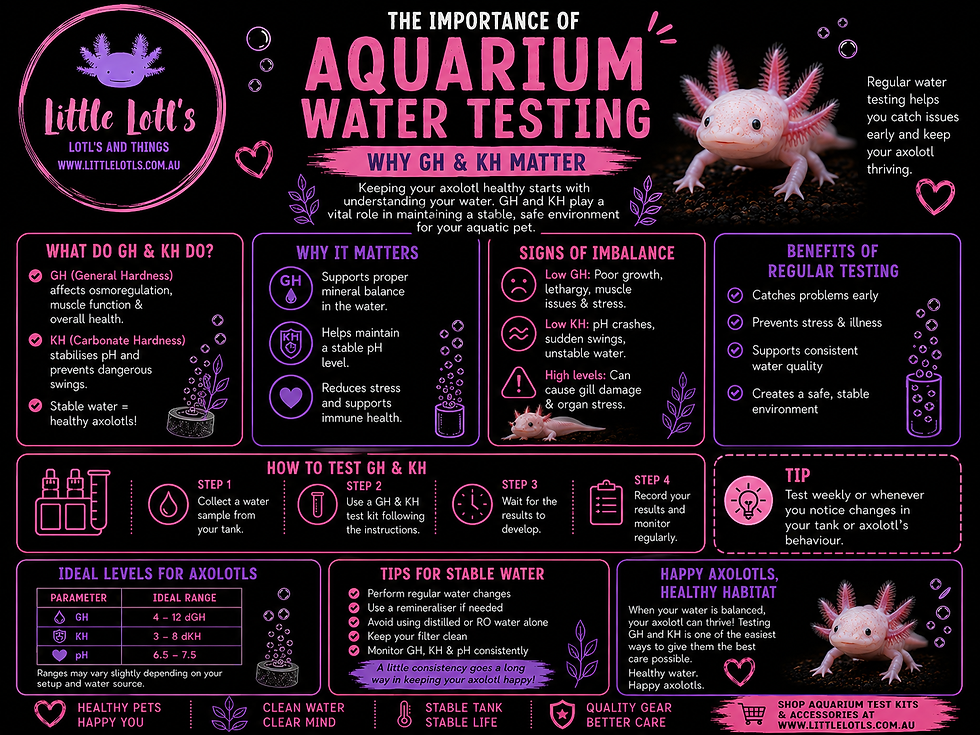
This is why regular testing and water changes are so important.
Your axolotl experiences the water around them the same way we experience the air we breathe.
How Often Should You Change the Water?
The answer depends on your setup.
Fully Cycled Aquarium
Most established axolotl tanks benefit from:
20% to 30% water changes every week
Some heavily stocked tanks may require larger or more frequent changes depending on nitrate levels.
Always let your water test results guide your maintenance schedule.
Newly Cycled Tanks
New aquariums can be less stable while bacterial colonies mature.
Testing regularly and performing water changes when nitrates rise helps maintain excellent conditions.
Tubbed Axolotls
Axolotls kept in temporary tubs require:
100% daily water changes
This is because tubs typically have no biological filtration to process waste.
Fresh dechlorinated water every day keeps the environment safe and clean.
How Do You Perform a Water Change?
Many beginners worry they'll accidentally hurt their axolotl during maintenance.
Fortunately, water changes are straightforward.
Step 1: Prepare Fresh Water
Fill a bucket or container with tap water.
Add a quality water conditioner to remove chlorine and chloramine.
Never add untreated tap water directly to your aquarium.
Step 2: Match the Temperature
Try to keep replacement water close to the aquarium's existing temperature.
Large temperature swings can stress axolotls.
A difference of a few degrees is usually acceptable, but dramatic changes should be avoided.
Step 3: Remove Old Water
Use a siphon or gravel vacuum to remove the desired amount of water.
This is also a great opportunity to remove debris and waste from the bottom of the tank.
Step 4: Slowly Add Fresh Water
Pour the conditioned water back into the aquarium slowly.
Many keepers pour onto a plate, decoration, or filter spray bar to reduce disturbance.
Step 5: Enjoy Watching Your Axolotl Investigate
Most axolotls become surprisingly curious during maintenance.
Some supervise closely.
Others inspect every hose and bucket as though conducting a safety audit.
How Much Water Should You Change?
Contrary to some myths, large water changes are not automatically dangerous.
What matters most is stability.
For most healthy aquariums:
20% to 30% weekly is ideal.
If nitrate levels become elevated, larger water changes may be necessary.
If an emergency occurs, such as detectable ammonia or nitrite, significant water changes may be required immediately.
Clean water is almost always safer than polluted water.
Signs Your Tank May Need a Water Change
Your test kit should always be your primary guide, but common clues include:
• Rising nitrate levels
• Increased debris accumulation
• Reduced water clarity
• Excess algae growth
• Unusual odours
• Increased waste accumulation
Remember that harmful water conditions are often invisible.
Testing remains the most reliable method.
The Biggest Water Change Mistakes
Forgetting Water Conditioner
Chlorine and chloramine are designed to kill microorganisms.
Unfortunately, they can also harm axolotls and beneficial bacteria.
Always treat tap water before use.
Changing Too Little Water
Tiny water changes may not effectively reduce nitrates.
Consistent maintenance is more important than occasional small changes.
Ignoring Water Testing
A schedule is helpful, but testing tells the real story.
Every aquarium is different.
Waiting Until Problems Appear
Water changes work best as prevention rather than treatment.
Regular maintenance keeps issues from developing in the first place.
Fresh Water Equals Happy Axolotls
Water changes may not be the most exciting part of axolotl keeping, but they are one of the most important.
Every water change removes waste, replenishes minerals, supports your biological filter, and gives your axolotl a healthier environment to enjoy.
Think of it as housekeeping for an underwater dragon.
A few minutes each week can help your axolotl stay healthier, happier, and thriving for many years to come.
Your axolotl may never say thank you.
But healthy gills, a good appetite, and plenty of goofy axolotl antics are usually their way of showing appreciation.

Comments