


Understanding GH: Why General Hardness Matters in Axolotl Tanks


When caring for axolotls, most people quickly learn about ammonia, nitrite, nitrate, pH, and temperature.
But there is another important water parameter that often gets overlooked:
GH, also known as General Hardness.
GH plays an important role in your axolotl’s overall health, mineral balance, gill condition, growth, and comfort. It may sound technical at first, but once you understand what GH does, it becomes much easier to manage.
This guide explains what GH is, why it matters for axolotls, how to test it, and what to do if your GH is too low or too high.
What Is GH?
GH stands for General Hardness.
It measures the amount of dissolved minerals in your aquarium water, mainly:
Calcium
Magnesium
These minerals are naturally found in water and are important for aquatic animals.
In simple terms, GH tells you whether your water is soft or hard.
Soft water has fewer dissolved minerals.
Hard water has more dissolved minerals.
Axolotls generally do best in moderately hard water because they need minerals to support healthy body function, skin, gills, bones, and development.
Why GH Matters for Axolotls
Axolotls absorb minerals from their environment as well as from their food.
Because they live fully aquatic lives, the water around them directly affects their health.
Correct GH helps support:
Healthy gill function
Strong growth
Normal mineral balance
Good skin condition
Healthy bones and body structure
Stable long-term wellbeing
Comfortable water conditions
If GH is too low, the water may not provide enough essential minerals.
If GH is too high, the water may become overly mineral-rich and potentially uncomfortable.
Like most axolotl care, the goal is balance.
Little Lotl’s Recommended GH Range
For axolotls, Little Lotl’s recommends:
GH: 7 to 14 dGH
This range provides a healthy level of dissolved minerals without making the water excessively hard.
The full recommended axolotl water parameters are:
Temperature: 14°C to 18°C (57°F to 64°F)
pH: 7.2 to 8.2
Ammonia: 0 ppm
Nitrite: 0 ppm
Nitrate: Less than 20 ppm
GH: 7 to 14 dGH
KH: 4 to 8 dKH
GH should always be considered alongside the other parameters, especially pH and KH.
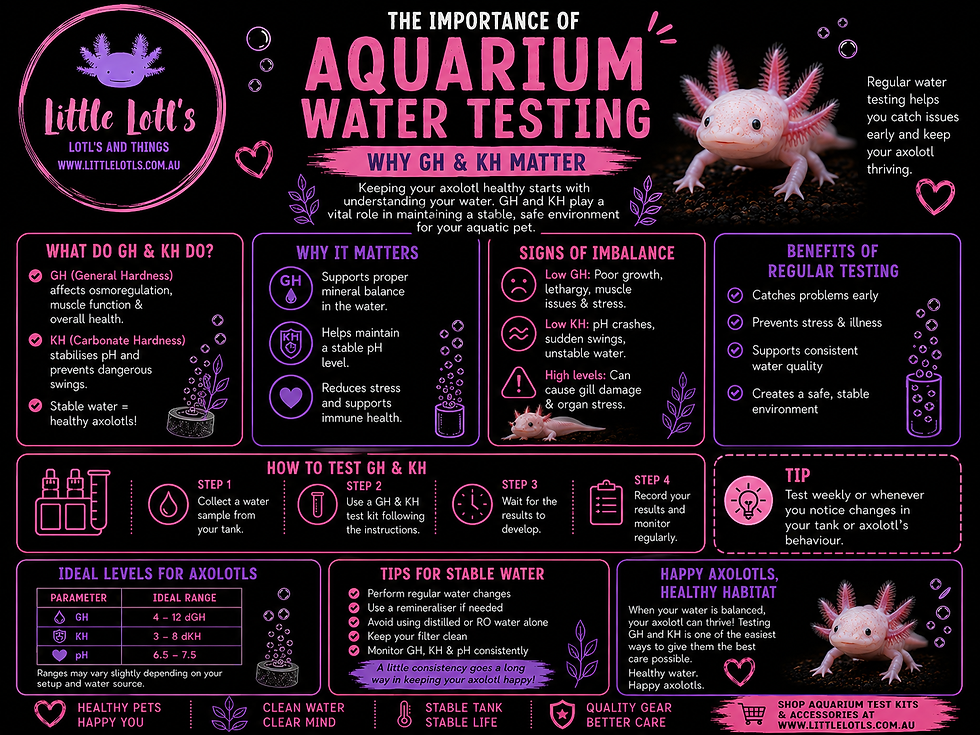
GH vs KH: What Is the Difference?
GH and KH are often confused, but they are not the same thing.
GH: General Hardness
GH measures dissolved minerals, mainly calcium and magnesium.
It affects mineral availability and overall water hardness.
KH: Carbonate Hardness
KH measures carbonate and bicarbonate levels.
It helps buffer pH and keep the aquarium stable.
Put simply:
GH = mineral content
KH = pH stability
Both are important, but they do different jobs.
A tank can have low GH and high KH, or high GH and low KH, depending on the water source and products used.
How Do You Test GH?
GH is usually tested with a liquid GH test kit.
The test commonly works by adding drops to a water sample until the colour changes.
Each drop usually represents one degree of hardness, known as dGH.
For example:
4 drops = 4 dGH
8 drops = 8 dGH
12 drops = 12 dGH
Always follow the instructions on your specific test kit.
Testing GH is especially useful if:
You use rainwater, RO water, or very soft tap water
Your axolotl has ongoing gill or skin concerns
You are cycling a new tank
You are moving house
Your tap water source changes
You are adjusting water minerals
You keep snails, shrimp, or live plants as well
Signs GH May Be Too Low
Low GH means the water does not contain enough dissolved minerals.
Possible signs of low GH problems may include:
Poor gill condition
Reduced growth in juveniles
Soft or unstable water chemistry
Difficulty maintaining healthy mineral balance
Increased sensitivity to water changes
General stress
Poor condition in snails or shrimp if kept separately in suitable setups
Low GH is common in some areas with naturally soft tap water.
If GH is too low, your axolotl may not be getting the mineral support it needs from the water.
Signs GH May Be Too High
High GH means the water contains a large amount of dissolved minerals.
Axolotls can tolerate moderately hard water, but very high GH may be less comfortable.
Possible issues with very high GH may include:
Mineral deposits on glass or equipment
Difficulty adjusting other water parameters
Increased hardness beyond the ideal range
Stress if changes happen suddenly
The biggest concern is not usually a slightly high GH. Sudden changes are often more stressful than a stable reading just outside the ideal range.
Stability matters.
Axolotls are not fans of surprise chemistry.
What Causes Low GH?
GH may be low if your water source contains very few minerals.
Common causes include:
Naturally soft tap water
Rainwater use
Reverse osmosis water
Distilled water
Heavy dilution with low-mineral water
Some water sources in soft-water regions
If you use RO, rainwater, or distilled water, it must be remineralised before being used for axolotls.
Plain RO or distilled water is not suitable on its own because it lacks essential minerals.
What Causes High GH?
GH may be high if your water source is naturally mineral-rich.
Common causes include:
Hard tap water
Limestone-based rocks
Crushed coral
Shell grit
Mineral additives
Evaporation concentrating minerals
Some substrates or décor
If water evaporates, minerals stay behind. Topping up evaporation without water changes can slowly increase hardness over time.
Regular water changes help keep minerals balanced.
How to Raise GH Safely
If GH is too low, raise it slowly.
Safe ways to increase GH may include:
Using an axolotl-safe GH mineral supplement
Using remineralised water
Adding minerals gradually during water changes
Testing regularly while adjusting
Do not make sudden large changes.
Raise GH slowly over time so your axolotl can adjust comfortably.
When using a GH supplement, follow the product directions carefully and test before and after dosing.
How to Lower GH Safely
If GH is too high, lower it slowly.
This may be done by gradually mixing in lower-GH water, such as properly prepared RO water, during water changes.
Important:
Never use plain RO or distilled water without remineralising appropriately
Avoid sudden swings
Test regularly
Adjust gradually
Keep pH and KH stable
Large sudden drops in GH can stress your axolotl.
A slow adjustment is much safer than a dramatic one.
Can You Use Bottled Water for Axolotls?
Bottled water is not automatically safe or suitable.
Some bottled water has very low minerals. Some has high minerals. Some may affect pH, GH, or KH.
Before using bottled water, test it for:
pH
GH
KH
Ammonia
Nitrite
Nitrate
Conditioned tap water is usually easier and more consistent for most keepers, provided it falls within suitable ranges or can be adjusted safely.
Does GH Affect pH?
GH and pH are connected but not the same.
GH measures minerals.
pH measures acidity or alkalinity.
KH has a stronger role in stabilising pH, but GH can still be part of the overall water chemistry picture.
This is why it is helpful to test GH, KH, and pH together rather than looking at only one number.
GH and Live Plants
Some aquarium plants do better when minerals are available in the water.
Very soft water may limit plant growth, depending on the species.
Hardy beginner plants such as Java fern, Anubias, Elodea, Hornwort, Java moss, Vallisneria, Amazon sword, Subwassertang, and floating plants can often do well in axolotl-safe conditions, but stable water is still important.
Plants are lovely little water-roommates, but axolotl safety always comes first.
GH and Tank Cycling
Beneficial bacteria need stable conditions to thrive.
GH is not the only factor in cycling, but overall mineral balance can support a stable aquarium environment.
For cycling, you should monitor:
Ammonia
Nitrite
Nitrate
pH
KH
GH
Temperature
If your water is very soft, low KH and low GH may contribute to unstable conditions.
This is why testing GH and KH can help when a tank seems stuck or unpredictable.
Should You Chase a Perfect GH Number?
No.
Do not chase perfect numbers every day.
The goal is a safe, stable range.
For axolotls, aim for 7 to 14 dGH, but avoid constantly adjusting the tank unless there is a clear issue.
Constant chemical changes can stress axolotls more than a stable reading that is only slightly outside ideal.
Test, understand the trend, and adjust slowly if needed.
Common GH Mistakes to Avoid
Avoid these common GH problems:
Never testing GH
Using RO or distilled water without minerals
Raising GH too quickly
Lowering GH too quickly
Confusing GH with KH
Assuming clear water means correct minerals
Adding random rocks or shells without testing
Overusing mineral products
Forgetting that evaporation can concentrate minerals
GH is not scary once you know what it means.
It is just another piece of the water-quality puzzle.
Little Lotl’s GH Checklist
For healthy axolotl water:
Test GH with a reliable kit
Aim for 7 to 14 dGH
Keep changes gradual
Test KH and pH as well
Avoid plain RO or distilled water
Use axolotl-safe products only
Keep water cool and clean
Watch your axolotl’s behaviour and gill condition
Do regular water changes
Final Thoughts
GH is an important part of axolotl water care.
It tells you how much calcium and magnesium are available in the water and helps you understand whether your tank water is too soft, too hard, or just right.
For axolotls, a GH range of 7 to 14 dGH is a great target.
When GH is stable, your axolotl has better mineral support, healthier water conditions, and a more comfortable environment.
As always, the best care comes back to the basics:
Clean water. Cool temperatures. Stable parameters. Regular testing.
Get those right, and your little lotl has a much better chance of thriving.

Comments