


Why KH Axolotl Buffer Is Essential for Stable, Safe Water Conditions


Water stability is one of the most important — and most misunderstood — aspects of axolotl care. While many keepers focus on ammonia, nitrite, and nitrate, there is another parameter that quietly determines whether your tank remains safe: KH (carbonate hardness).
KH acts as the tank’s natural “shock absorber,” preventing sudden pH crashes that can harm or even burn your axolotl. Your KH Axolotl Buffer 7.2 is formulated specifically to raise and stabilise KH, protect against acid drops, and support long‑term water stability.
Why KH Matters for Axolotls
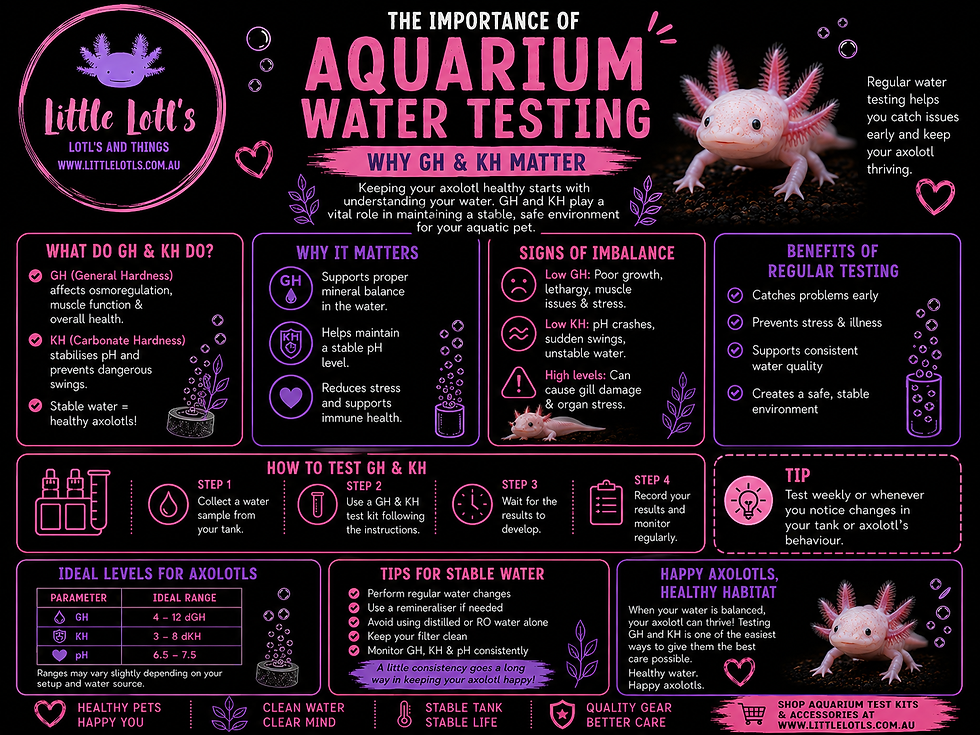
KH measures the amount of carbonate and bicarbonate ions in the water. These minerals buffer the pH, keeping it from dropping too quickly. When KH is too low, the pH becomes unstable and can fall into acidic levels.
Tap water often has low buffering capacity, meaning it can experience rapid pH drops. Low pH water becomes acidic, and acidic water can cause painful acid burns to axolotls.
A stable KH level prevents this by:
Holding pH steady
Reducing stress
Protecting delicate gill tissue
Supporting a healthy biological filter
Without adequate KH, even a well‑cycled tank can become unstable.
What KH Axolotl Buffer Does
KH Axolotl Buffer is designed to:
Raise KH (carbonate hardness)
Stabilise pH at over 7.2
Reduce stress
Prevent acid burn
Add calcium for strong bones
Provide chemically clean phosphates that do not exacerbate algae
This combination supports both axolotl health and the tank’s biological filtration system.
Why Axolotls Need a Stable pH
Axolotls thrive in slightly alkaline, stable water. Sudden pH swings — even small ones — can cause:
Gill irritation
Stress and lethargy
Appetite loss
Increased susceptibility to illness
Damage to skin and external gills
A stable KH level ensures the pH remains consistent, even as waste breaks down or water changes occur.
When KH Buffer Is Needed
1. Setting Up a New Tank
Fresh tap water often lacks the carbonate hardness needed to maintain a stable pH.
2. After Water Changes
New water dilutes KH, making the tank more vulnerable to pH drops.
3. If You Notice pH Instability
Fluctuating pH readings are a clear sign that KH is too low.
4. In Soft‑Water Regions
Many areas of Australia naturally have soft water with low KH.
5. For Long‑Term Stability
Consistent KH helps maintain a strong biological filter and reduces stress on your axolotl.
How to Use KH Axolotl Buffer
A simple, precise dosing guideline:
1 level teaspoon (5g) per 10 litres
This raises KH by approximately 7 dKH (125 ppm)
Stabilises pH at over 7.2
Because KH is consumed over time by biological processes, it should be monitored and replenished as needed.
Why This Product Stands Out
Formulated specifically for axolotls
Raises KH quickly and safely
Stabilises pH without harsh chemicals
Includes calcium for bone strength
Uses clean phosphates that do not fuel algae
Prevents acid burn and stress
Generic aquarium buffers are often designed for fish and may not provide the mineral balance axolotls require. This buffer is tailored to their biology and environmental needs.
The Bottom Line
KH Axolotl Buffer is an essential tool for maintaining a safe, stable environment. By raising carbonate hardness and preventing dangerous pH drops, it protects your axolotl from acid burn, stress, and instability. Whether you’re setting up a new tank or maintaining an established one, KH Buffer is a core part of responsible axolotl care.


Comments