


Understanding Nitrate: Why It Matters in Your Axolotl Tank

When caring for axolotls, most keepers quickly learn that ammonia and nitrite must always be 0 ppm.
But what about nitrate?
Nitrate is the final stage of the aquarium nitrogen cycle. It is much less toxic than ammonia or nitrite, but that does not mean it should be ignored.
In an axolotl tank, nitrate can slowly build up over time. If it gets too high, it may stress your axolotl, affect water quality, and make the tank less healthy.
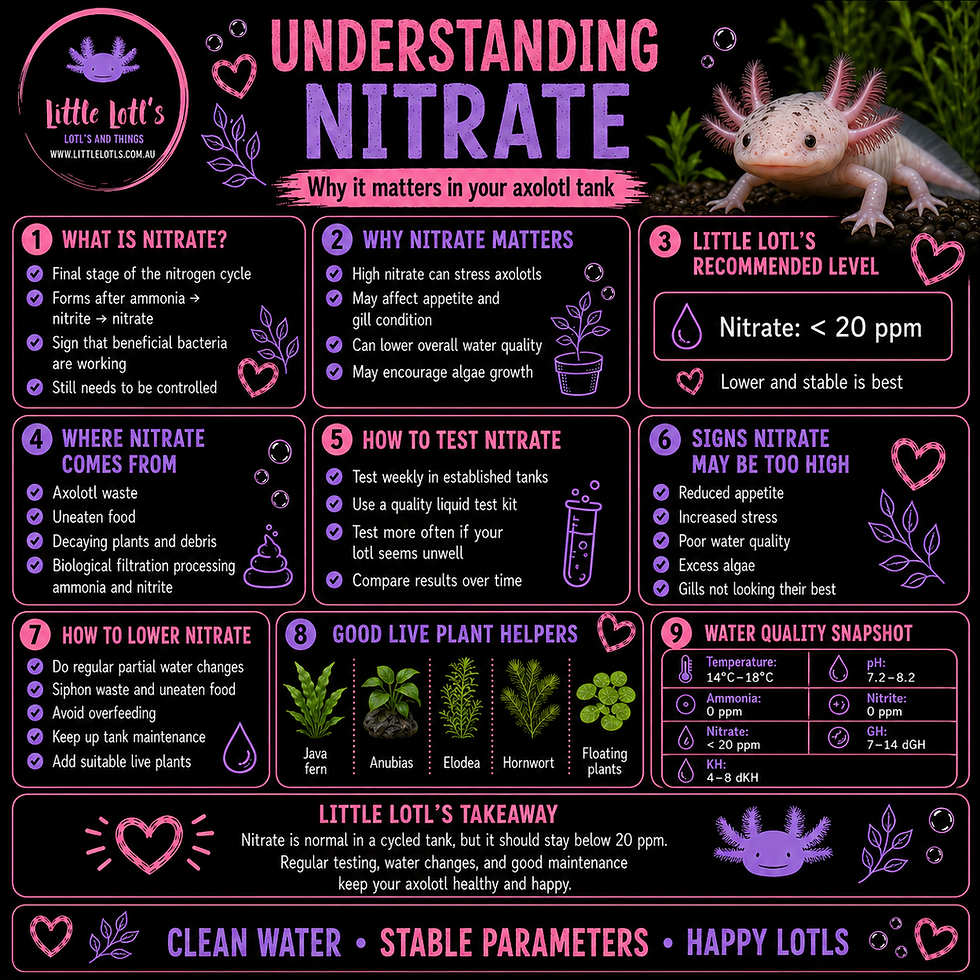
For axolotls, Little Lotl’s recommends keeping nitrate:
Nitrate: Less than 20 ppm
This guide explains what nitrate is, where it comes from, why it matters, how to test it, and how to keep nitrate under control in your axolotl aquarium.
What Is Nitrate?
Nitrate is a nitrogen compound that forms at the end of the aquarium nitrogen cycle.
In a healthy cycled tank, beneficial bacteria process waste in stages:
Ammonia is produced from waste, uneaten food, and decaying organic matter.
Beneficial bacteria convert ammonia into nitrite.
A second group of beneficial bacteria converts nitrite into nitrate.
Nitrate is the final product of this process.
This means nitrate is often a sign that your biological filter is working, but it still needs to be managed through regular maintenance.
Think of nitrate as the final crumb trail left behind by the nitrogen cycle. Better than toxic chaos, but still something you need to clean up.
Why Nitrate Matters for Axolotls
Nitrate is less dangerous than ammonia and nitrite, but high nitrate can still cause problems.
Axolotls are sensitive animals with delicate skin and gills. They rely on clean, stable water to stay healthy.
High nitrate may contribute to:
Stress
Reduced appetite
Poor gill condition
Lower water quality
Increased sensitivity to illness
General discomfort
Algae growth
Unhealthy tank conditions over time
Nitrate usually becomes a problem gradually rather than suddenly.
That is why regular testing and water changes are so important.
Little Lotl’s Recommended Nitrate Level
For axolotl aquariums, Little Lotl’s recommends:
Nitrate: Less than 20 ppm
The full recommended axolotl water parameters are:
Temperature: 14°C to 18°C (57°F to 64°F)
pH: 7.2 to 8.2
Ammonia: 0 ppm
Nitrite: 0 ppm
Nitrate: Less than 20 ppm
GH: 7 to 14 dGH
KH: 4 to 8 dKH
If nitrate rises above the recommended range, it is time to review water changes, feeding, cleaning, and overall tank maintenance.
Where Does Nitrate Come From?
Nitrate forms naturally when a tank is cycled.
It comes from the breakdown of:
Axolotl waste
Uneaten food
Decaying plants
Dead organisms
Organic debris
Ammonia and nitrite processed by beneficial bacteria
Unlike ammonia and nitrite, nitrate does not usually disappear on its own in a standard aquarium.
It needs to be removed or reduced through maintenance.
Nitrate and the Nitrogen Cycle
Nitrate is part of a working nitrogen cycle.
A fully cycled aquarium should usually show:
Ammonia: 0 ppm
Nitrite: 0 ppm
Nitrate: Present but controlled
This is an important point.
A nitrate reading can be a sign that the tank is processing waste properly. However, nitrate must still be kept low.
A tank with nitrate present is not automatically unsafe.
A tank with nitrate climbing too high needs attention.
How Do You Test for Nitrate?
Nitrate should be tested with a reliable aquarium test kit.
Liquid test kits are usually more accurate than strips, especially when monitoring important water quality trends.
Test nitrate:
Weekly in established tanks
During cycling
After tank moves or upgrades
If your axolotl seems unwell
Before and after water changes if nitrate is high
If algae is becoming a problem
If you suspect overfeeding or waste buildup
Nitrate tests often require shaking bottles and test tubes properly, so always follow the instructions carefully.
A poorly mixed nitrate test can give inaccurate results.
Signs Nitrate May Be Too High
High nitrate does not always cause instant dramatic symptoms, but it can slowly affect your axolotl and tank health.
Possible signs include:
Reduced appetite
Curled or stressed gills
Less activity
Poor gill appearance
Increased algae growth
Cloudy or dirty-looking tank
General stress
Water quality problems returning quickly after cleaning
These signs can also be caused by other issues, so always test ammonia, nitrite, nitrate, pH, temperature, GH, and KH when something seems off.
What Causes High Nitrate?
Nitrate builds up when more waste is being produced than regular maintenance can remove.
Common causes include:
Not enough water changes
Overfeeding
Uneaten food left in the tank
Too much waste buildup
Dirty substrate
Decaying plants
Overcrowding
Poor tank maintenance
Tap water that already contains nitrate
Filter maintenance issues
Tank too small for the waste load
Axolotls are messy little water potatoes, so nitrate can creep upward faster than some keepers expect.
What To Do If Nitrate Is Too High
If nitrate is above the recommended range, take action calmly and safely.
1. Do a Partial Water Change
Perform a partial water change using cool, dechlorinated water.
For many tanks, a 20 to 30 percent water change is a good starting point.
If nitrate is very high, you may need multiple smaller water changes over several days rather than one huge change.
Avoid sudden major changes unless there is an emergency.
2. Remove Waste and Uneaten Food
Use a siphon to remove:
Axolotl waste
Uneaten food
Dead plant matter
Debris
Hidden organic buildup
Removing waste helps stop nitrate from continuing to rise.
3. Review Feeding
Overfeeding is one of the easiest ways to increase nitrate.
Make sure food is appropriate for your axolotl’s size and age.
Remove leftovers promptly.
Adult axolotls usually do not need daily feeding, while babies and juveniles require more frequent meals.
4. Check Your Tap Water
Some tap water contains nitrate before it even enters the aquarium.
Test your tap water for nitrate so you know what you are starting with.
If your source water contains nitrate, you may need extra management strategies.
5. Add Suitable Live Plants
Live plants can help absorb some nitrate, although they should not replace water changes.
Good axolotl-friendly plant options may include:
Java fern
Anubias
Elodea
Hornwort
Java moss
Vallisneria
Amazon sword
Subwassertang
Floating plants
Plants can help support water quality, provide cover, and create a more natural tank environment.
6. Improve Maintenance Routine
If nitrate keeps rising quickly, your routine may need adjusting.
You may need:
Larger water changes
More frequent water changes
Better waste removal
Less feeding
More plant growth
Improved filtration
A larger tank
The goal is to create a routine that keeps nitrate consistently under control.
Can Nitrate Be 0 ppm?
In some tanks, nitrate may test very low or even 0 ppm.
This can happen if:
The tank is heavily planted
The tank is not fully cycled
The test was performed incorrectly
There is very little waste being produced
The tank is new and nitrate has not appeared yet
During cycling, 0 nitrate may mean the cycle has not reached the final stage yet.
In an established tank with axolotls, some nitrate is usually expected unless plants are using it quickly or water changes are very frequent.
Always look at ammonia, nitrite, and nitrate together.
Nitrate vs Nitrite: What Is the Difference?
Nitrite and nitrate sound almost the same, but they are very different.
Nitrite
Nitrite is toxic and should always be:
0 ppm
If nitrite is present, the tank is unsafe.
Nitrate
Nitrate is less toxic but still needs to be controlled.
Little Lotl’s recommends:
Less than 20 ppm
In simple terms:
Nitrite = urgent danger
Nitrate = manageable, but do not let it build up
Do Filters Remove Nitrate?
Most standard aquarium filters do not remove nitrate.
Filters mainly help convert ammonia into nitrite, then nitrite into nitrate.
This is why nitrate usually increases over time in a cycled aquarium.
Nitrate is mainly controlled through:
Water changes
Waste removal
Live plants
Avoiding overfeeding
Good maintenance
Appropriate stocking
Testing regularly
Your filter creates nitrate by doing its job. Your maintenance routine removes it.
Teamwork, but with bacteria.
Do Live Plants Remove Nitrate?
Live plants can help absorb nitrate as they grow.
However, plants should not be relied on as the only nitrate control method.
Plants work best alongside:
Regular water changes
Good filtration
Waste removal
Proper feeding
Testing
Fast-growing plants and floating plants may use nitrate more quickly than slow-growing plants.
But even planted axolotl tanks still need maintenance.
How Often Should You Do Water Changes?
Most established axolotl tanks benefit from weekly partial water changes.
A common routine is:
20 to 30 percent weekly water change
Siphon waste as needed
Remove uneaten food after feeding
Test nitrate weekly
Some tanks may need more frequent water changes depending on nitrate levels, tank size, feeding routine, and waste load.
Let the test results guide you.
Common Nitrate Mistakes to Avoid
Avoid these common nitrate problems:
Never testing nitrate
Assuming clear water means clean water
Overfeeding
Leaving uneaten food in the tank
Skipping water changes
Ignoring dirty substrate
Forgetting to test tap water
Relying only on plants
Letting nitrate creep higher over time
Nitrate is sneaky because it usually builds slowly.
Regular testing catches it before it becomes a problem.
Little Lotl’s Nitrate Checklist
For healthy axolotl water:
Keep nitrate less than 20 ppm
Test nitrate weekly
Test ammonia and nitrite as well
Perform regular partial water changes
Siphon waste and debris
Remove uneaten food quickly
Avoid overfeeding
Test tap water if nitrate keeps rising
Use live plants as extra support
Keep filtration and maintenance consistent
Final Thoughts
Nitrate is a normal part of a cycled aquarium, but it still needs to be controlled.
A healthy axolotl tank should have:
Ammonia: 0 ppm
Nitrite: 0 ppm
Nitrate: Less than 20 ppm
When nitrate stays low, your axolotl has cleaner, safer, more stable water.
Regular testing, weekly water changes, proper feeding, and good tank maintenance are the keys to keeping nitrate under control.
Clean water is not just about what you can see.
It is about what your test kit can reveal.
And when nitrate stays low, your lotl gets a safer, happier home.


Comments