


What Is pH? Understanding pH in Axolotl Tanks

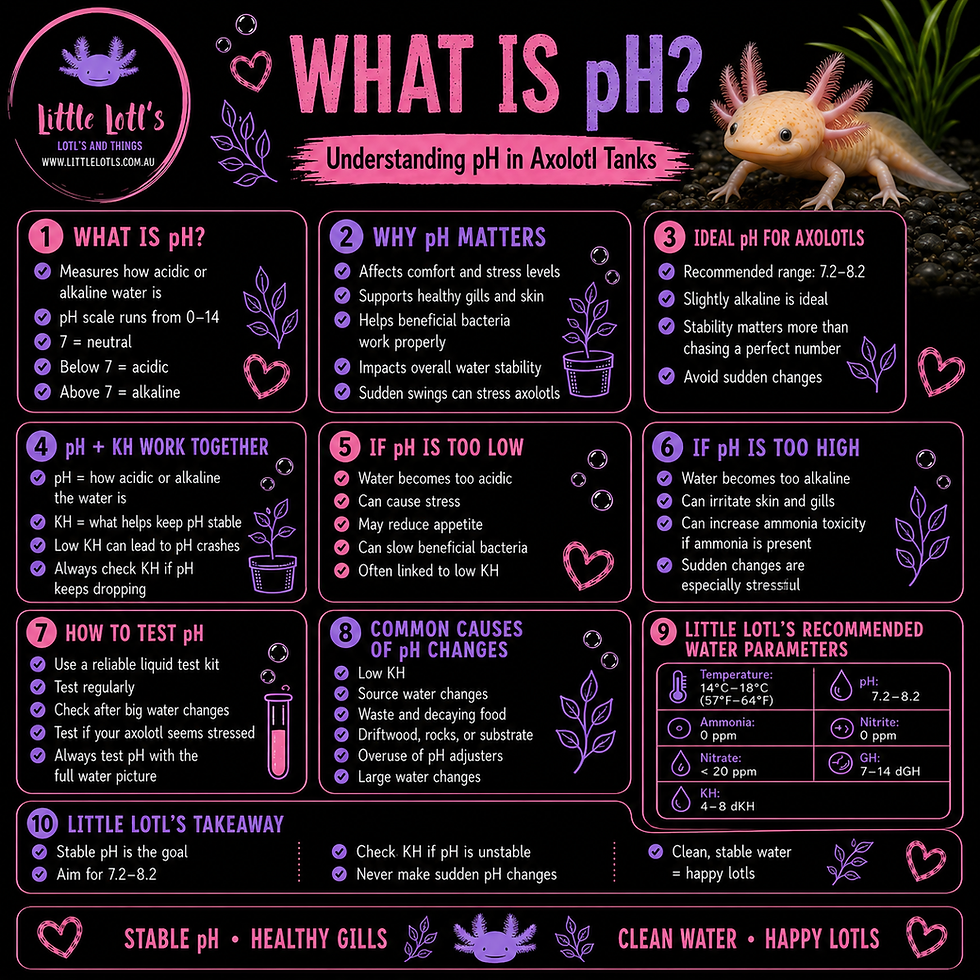
When caring for axolotls, water quality is one of the most important parts of keeping them healthy.
Most keepers learn quickly about ammonia, nitrite, nitrate, temperature, GH, and KH, but one parameter that often causes confusion is:
pH.
pH tells you whether your aquarium water is acidic, neutral, or alkaline. For axolotls, pH matters because it affects comfort, stress levels, biological filtration, and overall water stability.
The good news is that pH is not scary once you understand what it means.
This guide explains what pH is, why it matters for axolotls, the ideal pH range, what causes pH changes, and how to keep your tank stable.
What Is pH?
pH is a measurement of how acidic or alkaline water is.
The pH scale usually runs from:
0 to 6.9: acidic
7: neutral
7.1 to 14: alkaline
Axolotls prefer slightly alkaline water.
For axolotl aquariums, Little Lotl’s recommends:
pH: 7.2 to 8.2
This range helps provide comfortable, stable water conditions for most axolotls.
Why pH Matters for Axolotls
Axolotls live completely in water, so their environment directly affects their skin, gills, appetite, behaviour, and overall health.
Stable pH helps support:
Healthy gill function
Comfortable water conditions
A stable nitrogen cycle
Beneficial bacteria
Reduced stress
Better long-term tank stability
Axolotls do not like sudden changes.
A pH reading slightly outside the ideal range may be less stressful than a pH that swings up and down quickly.
Stability is the real treasure chest.
Little Lotl’s Recommended pH Range
For axolotls, aim for:
pH: 7.2 to 8.2
Little Lotl’s recommended axolotl water parameters are:
Temperature: 14°C to 18°C (57°F to 64°F)
pH: 7.2 to 8.2
Ammonia: 0 ppm
Nitrite: 0 ppm
Nitrate: Less than 20 ppm
GH: 7 to 14 dGH
KH: 4 to 8 dKH
pH should always be considered alongside KH, because KH helps buffer and stabilise pH.
pH and KH: Why They Work Together
pH and KH are closely connected.
pH tells you how acidic or alkaline the water is.
KH tells you how well the water resists pH changes.
KH is also known as carbonate hardness or alkalinity.
In simple terms:
pH = where your water is sitting
KH = how well your water stays there
If KH is too low, pH can drop suddenly. This is often called a pH crash.
That is why pH problems are often really KH problems wearing a tiny disguise.
What Happens If pH Is Too Low?
Low pH means the water is becoming too acidic.
For axolotls, pH below the recommended range can cause stress and may affect the biological filter.
Possible issues with low pH include:
Stress
Reduced appetite
Slower beneficial bacteria activity
Unstable water chemistry
Increased risk of a stalled cycle
pH crashes if KH is also low
If pH is dropping over time, check KH immediately.
Low KH is one of the most common reasons pH becomes unstable.
What Happens If pH Is Too High?
High pH means the water is more alkaline.
Axolotls can usually tolerate mildly alkaline water within the recommended range, but very high pH may cause discomfort or make ammonia more dangerous.
Possible issues with high pH include:
Stress
Irritated gills or skin
Difficulty adjusting water chemistry
Increased ammonia toxicity if ammonia is present
Uncomfortable water conditions if changes happen suddenly
If pH is high but stable, do not panic.
Test the full water picture before making changes.
Why pH Stability Matters More Than Chasing Numbers
Many new keepers see a pH reading and immediately want to adjust it.
This can cause more harm than good.
Axolotls are often more stressed by sudden pH changes than by a stable pH that is slightly outside the perfect target.
Avoid chasing pH with constant chemical adjustments.
Instead, focus on:
Stable KH
Regular testing
Safe source water
Proper water changes
Avoiding sudden changes
Keeping ammonia and nitrite at 0 ppm
A steady tank is usually a safer tank.
What Causes pH to Change?
pH can change for many reasons.
Common causes include:
Low KH
Water source changes
Decaying organic matter
Uneaten food
Axolotl waste
Cycling activity
Certain rocks or substrates
Driftwood or botanicals
Overuse of pH-adjusting products
Large water changes with different source water
Tap water chemistry changes
If your pH changes suddenly, do not guess.
Test pH, KH, ammonia, nitrite, nitrate, GH, and temperature to get the full story.
How to Test pH
pH should be tested with a reliable aquarium test kit.
Liquid test kits are usually more accurate than strips.
Test pH:
During cycling
Before adding an axolotl
As part of regular tank maintenance
After large water changes
If your axolotl seems stressed
If ammonia or nitrite appears
If you move house or change water source
When KH is low or unstable
Always follow the test kit instructions carefully.
pH and Ammonia Toxicity
pH is especially important when ammonia is present.
Ammonia becomes more toxic at higher pH and warmer temperatures.
This is one reason axolotl keepers must always aim for:
Ammonia: 0 ppm
If ammonia is present, the tank is unsafe regardless of pH.
Do not try to “balance” ammonia with pH.
Fix the ammonia problem.
Clean, cycled water is the hero here.
How to Raise pH Safely
If pH is too low, first check KH.
If KH is low, raising KH gradually can help stabilise pH.
Safe options may include:
Using an axolotl-safe KH buffer
Adjusting source water before adding it to the tank
Making gradual changes during water changes
Testing regularly while adjusting
Never make sudden large pH changes.
Raise pH slowly and carefully.
How to Lower pH Safely
Lowering pH is less commonly needed for axolotl tanks unless the pH is extremely high or causing problems.
Before lowering pH, check:
KH
GH
Tap water pH
Ammonia
Nitrite
Nitrate
Any rocks, shells, coral, or substrates that may raise pH
Lowering pH should be done gradually and carefully.
Avoid quick-fix chemicals that cause sudden swings.
A stable pH within or close to the recommended range is usually better than constant adjustments.
Should You Use pH Up or pH Down Products?
Be careful with pH-adjusting products.
They can cause sudden swings if used incorrectly, especially if KH is not stable.
Before using pH products:
Test KH
Test GH
Test your tap water
Understand why pH is changing
Make changes slowly
Use only aquarium-safe products
Follow directions carefully
For most axolotl tanks, managing KH and source water is safer than repeatedly using quick pH fixes.
Can Tap Water pH Change?
Yes.
Tap water pH can vary depending on your area, water treatment, rainfall, seasonal changes, and supply changes.
This is why testing your tap water can be useful, especially if:
You move house
Your tank suddenly behaves differently
pH changes after water changes
You are cycling a new tank
Your KH or GH seems unusual
If your tap water sits in a bucket for 24 hours, pH may also shift as gases exchange with the air.
Signs pH May Be Causing Stress
pH problems can look similar to other water quality issues.
Possible signs of stress include:
Curled gills
Forward-facing gills
Loss of appetite
Lethargy
Hiding more than usual
Restlessness
Unusual floating
Irritated skin
Sudden behaviour changes
These signs do not automatically mean pH is the problem.
Always test the full set of water parameters before deciding what to change.
Common pH Mistakes to Avoid
Avoid these common pH mistakes:
Chasing a perfect number
Ignoring KH
Using pH up or pH down without testing KH
Making sudden changes
Forgetting to test tap water
Assuming clear water means safe water
Ignoring ammonia at higher pH
Adding rocks, shells, or substrates without testing
Changing too many things at once
pH is only one piece of the water-quality puzzle.
Do not let it run the whole circus.
Little Lotl’s pH Checklist
For healthy axolotl water:
Aim for pH 7.2 to 8.2
Keep KH between 4 and 8 dKH
Keep GH between 7 and 14 dGH
Test pH regularly
Avoid sudden pH changes
Keep ammonia at 0 ppm
Keep nitrite at 0 ppm
Keep nitrate under 20 ppm
Use conditioned water
Adjust slowly if needed
Final Thoughts
pH is an important part of axolotl water care, but it should never be managed in isolation.
The ideal axolotl pH range is:
pH: 7.2 to 8.2
More importantly, the pH should stay stable.
If your pH keeps changing, check KH. If your axolotl seems stressed, test all water
parameters. If ammonia or nitrite is present, act quickly.
Healthy axolotl care comes back to the basics:
Clean water. Cool temperatures. Stable parameters. Regular testing.
When pH is steady and the tank is properly maintained, your axolotl has a safer, calmer, happier home.


Comments