


Can Axolotls Really Morph? The Truth About Axolotl Metamorphosis

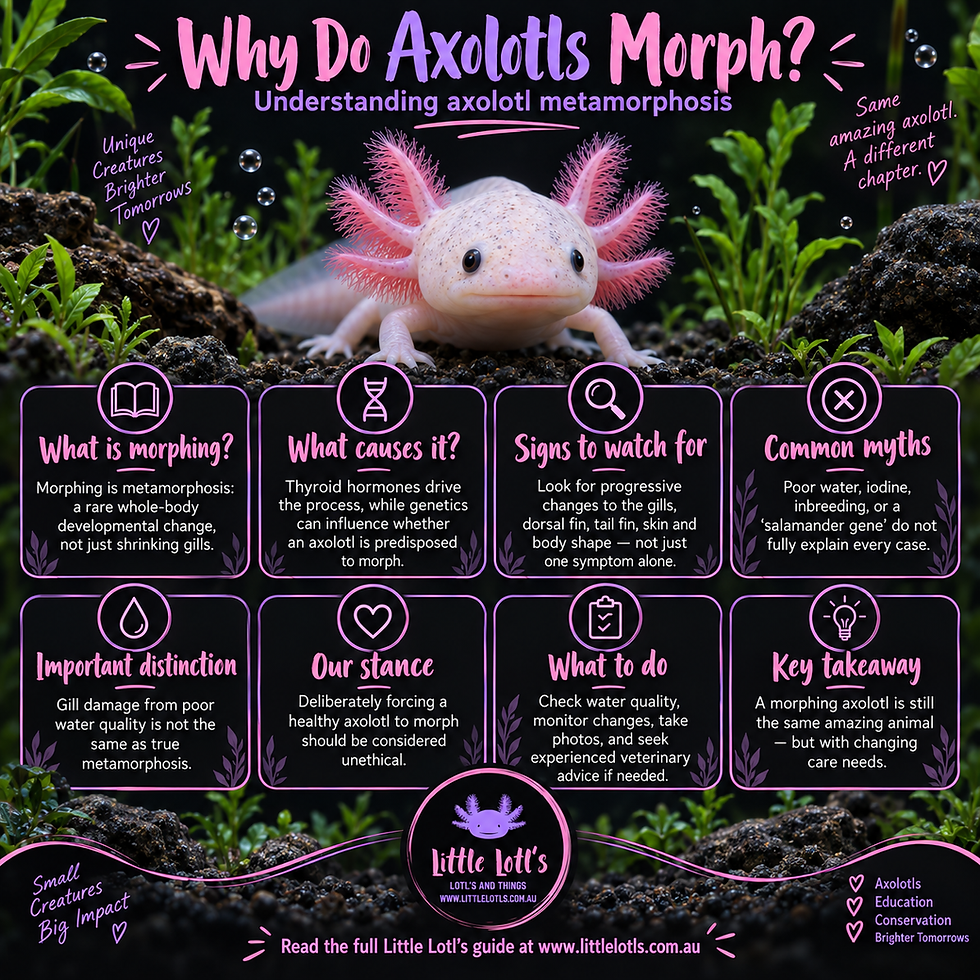
If you spend enough time in axolotl groups online, sooner or later you will see a photo of an animal with shrinking gills and someone will say:
“It’s morphing.”
Then the explanations start.
“It must have bad water.”
“It’s because it was inbred.”
“It got too much iodine.”
“It has a salamander gene.”
Some of these ideas contain tiny pieces of real biology. Others are misunderstandings that have been repeated so often they have started to sound like established fact.
The real science behind axolotl metamorphosis is far more interesting.
Axolotls can undergo metamorphosis, but true morphing is not simply an axolotl losing its fluffy gills. It is a major hormone-controlled developmental transformation involving changes throughout the animal’s body.
So, why does it happen?
Axolotls are already salamanders
The first myth we need to clear up is the idea that a morphing axolotl “turns into a salamander.”
It does not.
An axolotl, Ambystoma mexicanum, is already a salamander.
What makes axolotls unusual is that they normally reach adulthood while keeping features that most other salamanders lose during metamorphosis, including their external gills, aquatic tail fin and fully aquatic lifestyle.
This is called paedomorphosis.
In simple terms, an axolotl becomes a sexually mature adult while retaining several juvenile aquatic characteristics.
This is completely normal for the species. An adult axolotl with external gills is not unfinished, defective or waiting for the next stage of development.
Research into axolotl endocrinology shows that this paedomorphic lifestyle is closely associated with relatively low activity of the hormonal pathway responsible for amphibian metamorphosis.
So what actually controls metamorphosis?
The main biological driver is thyroid hormone.
Amphibian metamorphosis is controlled largely through the hypothalamic-pituitary-thyroid system.
Very simply, hormonal signals stimulate the thyroid gland, thyroid hormones are released, and those hormones switch on developmental changes throughout the body.
Axolotls retain the ability to respond to these hormones.
Scientists can experimentally induce metamorphosis by exposing axolotls to thyroid hormones under controlled research conditions.
That tells us something very important.
The biological machinery required for metamorphosis has not disappeared from the axolotl.
Under normal circumstances, it simply is not strongly activated.
What happens when an axolotl genuinely morphs?
This is where the difference between gill problems and true metamorphosis becomes important.
A morphing axolotl does not simply wake up one morning with smaller gills.
Scientific studies examining induced metamorphosis have documented a sequence of changes involving the external gills, dorsal and tail fins, body proportions, skin structure and gene expression.
The external gills gradually resorb.
The fin running along the back and tail reduces.
The skin undergoes substantial restructuring and becomes better suited to a terrestrial existence.
Changes are also happening inside the animal that are invisible from the outside.
Researchers have shown that changes in gene expression occur alongside the obvious physical transformation.
True metamorphosis is therefore better understood as a whole-body developmental programme, not a gill condition.
Does bad water make axolotls morph?
This is one of the claims we see repeated most often.
Poor water quality can absolutely harm an axolotl.
Ammonia, nitrite, unsuitable temperatures and unstable aquarium conditions can cause stress, illness, damaged skin and deteriorating gills.
But this does not mean every axolotl with shrinking or unhealthy gills is metamorphosing.
Gill filaments can reduce because an animal is unwell or its environment is inappropriate without the animal undergoing the endocrine process of metamorphosis.
This is why we strongly recommend checking water quality and overall health before assuming a change in gill appearance means an axolotl is morphing.
There is scientific evidence that stress-related hormonal systems can interact with thyroid signalling during amphibian metamorphosis, so researchers are interested in these hormonal relationships.
That is very different from saying:
“Bad water makes axolotls morph.”
At present, that statement is far too simplistic.
Is morphing caused by inbreeding?
Genetics certainly matters.
Studies of axolotls and related salamanders have identified genetic influences that affect paedomorphosis and metamorphic timing.
But that does not mean every axolotl that morphs has done so because it was closely bred.
The genetics behind metamorphosis are considerably more complicated than that.
Different axolotl lines can carry different combinations of genes affecting development, and the genetic background of laboratory populations can differ from wild-derived animals.
So while breeding history may influence which traits become more common within captive populations, “it morphed because it was inbred” should not be presented as an established diagnosis.
There may be a genetic predisposition without us being able to identify the exact reason an individual animal crossed the threshold into metamorphosis.
What about the famous “salamander gene”?
This one has a particularly stubborn life on social media.
The story usually goes that an axolotl has a dormant salamander gene, often supposedly from a tiger salamander, and occasionally that gene “switches on.”
There is some genuine scientific history hiding underneath this myth.
Certain important laboratory axolotl populations do contain documented tiger salamander ancestry because of historical hybridisation within research colonies.
However, that does not mean every domestic axolotl carries one special tiger salamander gene responsible for morphing.
And remember: an axolotl is already a salamander.
Metamorphosis involves many genes, developmental signals and hormones rather than one magical biological light switch.
Does iodine make axolotls morph?
Another common claim is that iodine automatically triggers metamorphosis.
This idea probably comes from the fact that iodine is involved in thyroid hormone biology.
That part is true.
The conclusion that follows is usually not.
Thyroid hormones contain iodine, but that does not mean simply exposing an axolotl to iodine will predictably or safely cause metamorphosis.
The endocrine pathway controlling metamorphosis is much more complicated than adding one ingredient to the water.
Owners should never deliberately administer iodine, thyroid medication or similar substances in an attempt to make an axolotl morph.
Why would anyone deliberately make an axolotl morph?
Scientists sometimes induce metamorphosis because axolotls are extremely valuable research animals.
Comparing an aquatic paedomorphic axolotl with the same species after metamorphosis can teach researchers an enormous amount about hormones, development, tissue biology and regeneration.
That work is performed for legitimate scientific purposes under controlled conditions.
Deliberately forcing metamorphosis in a healthy pet or breeding axolotl for curiosity, appearance or novelty is another matter entirely.
At Little Lotl’s Australia, we consider deliberately forcing an otherwise healthy axolotl to morph to be unethical from an animal-welfare perspective.
An aquatic adult axolotl is already in its normal biological form.
There is no welfare benefit in artificially pushing it through a major endocrine transformation simply because it is possible.
Research has shown that metamorphosis can also have significant biological consequences.
For example, experimentally metamorphosed axolotls were found to regenerate limbs more slowly and with reduced fidelity compared with paedomorphic animals.
That does not mean a naturally morphing axolotl should be viewed negatively.
Quite the opposite.
If metamorphosis begins naturally, the keeper's responsibility is to recognise the change and provide appropriate care.
There is a very important difference between supporting an animal through a process that has begun spontaneously and deliberately causing that process for human curiosity.
How can you tell if an axolotl is actually morphing?
One physical change on its own is not enough.
Reduced gills certainly deserve attention, but they can happen for several reasons.
With true metamorphosis you would expect to see a progressive combination of changes involving the gills, dorsal fin, tail fin, skin, body shape and behaviour.
The important word is progressive.
Taking clear photographs every few days from similar angles can help determine whether several parts of the animal are genuinely changing.
At the same time, water parameters and temperature should be checked carefully to rule out more common husbandry problems.
If significant changes continue, advice from a veterinarian experienced with amphibians or exotic species should be sought where possible.
Can an adult axolotl suddenly morph?
Potentially, yes.
Axolotls retain the biological ability to respond to thyroid hormone even after reaching maturity, and adult animals have been induced to metamorphose experimentally.
There is therefore no scientific basis for absolute statements such as:
“If it hasn't morphed by one year old, it never will.”
Spontaneous metamorphosis is unusual, but age alone does not completely remove the underlying biological ability.
Can you stop a morph once it starts?
Once genuine complete metamorphosis is progressing, it should not be thought of as something that can simply be switched backwards.
This is a developmental transformation involving extensive remodelling of tissues throughout the body.
A completely metamorphosed axolotl should therefore not be expected to simply regrow its external gills and return to its previous aquatic form.
This is another reason keepers should be extremely cautious about attempting to manipulate the process themselves.
So why did my axolotl morph?
Sometimes the most accurate answer is:
We don't know exactly.
That can be frustrating, but it is also scientifically responsible.
We know that thyroid-hormone signalling drives the metamorphic process.
We know that genetics can influence metamorphic development.
We know that hormonal systems interact with one another.
What we cannot always do is look at one individual pet axolotl and confidently identify the exact event that caused its developmental programme to change.
That means claims such as:
“Bad water caused it.”
“It was inbred.”
“It got iodine.”
or
“The salamander gene switched on.”
should be treated cautiously unless there is actual evidence supporting that conclusion.
Axolotl metamorphosis is one of those subjects where the science is already fascinating enough without adding mythology.
The important thing to remember
A normal adult axolotl is already exactly what it is supposed to be: an aquatic, paedomorphic salamander.
Most will remain that way throughout their lives.
Very occasionally, an individual may undergo metamorphosis.
When that happens, it is a complex biological transformation driven by endocrine and developmental mechanisms rather than simply an axolotl deciding to lose its gills.
If you think your axolotl may be morphing, first check its water quality, temperature and health, document any physical changes carefully, and seek experienced veterinary advice where possible.
And most importantly, never attempt to deliberately force metamorphosis.
Want to read the science in more detail?
We have also created a comprehensive Little Lotl’s guide to Why Axolotls Morph, covering the thyroid system, genetics, inbreeding claims, tiger salamander ancestry, iodine, water quality, signs of genuine metamorphosis and the scientific studies behind what we currently know.
Read our complete guide: Why Do Axolotls Morph? Understanding Axolotl Metamorphosis, Causes, Signs and the Science Behind It.
Sources
De Groef, B., Grommen, S. V. H. & Darras, V. M. (2018). Forever young: Endocrinology of paedomorphosis in the Mexican axolotl (Ambystoma mexicanum). General and Comparative Endocrinology, 266, 194–201.
Page, R. B., Monaghan, J. R., Walker, J. A. & Voss, S. R. (2009). A model of transcriptional and morphological changes during thyroid hormone-induced metamorphosis of the axolotl. General and Comparative Endocrinology, 162, 219–232.
Johnson, C. K. & Voss, S. R. (2019). Rediscovering the Axolotl as a Model for Thyroid Hormone Dependent Development. Frontiers in Endocrinology, 10, 237.
Monaghan, J. R. et al. (2014). Experimentally induced metamorphosis in axolotls reduces regenerative rate and fidelity. Regeneration, 1, 2–14.


Comments