


Anubias Barteri Care Guide: A Hardy Live Plant for Axolotl Aquariums
- Veronica And Erik

- Aug 10
- 7 min read

Anubias barteri is one of the toughest and easiest live aquarium plants available, making it an excellent choice for beginners, low-light aquariums and axolotl tanks.
With broad green leaves, strong roots and a slow-growing nature, Anubias barteri adds natural shelter and greenery without demanding complicated lighting, injected carbon dioxide or nutrient-rich aquarium soil.
There is one important rule, however: never bury its rhizome.
This guide explains how to plant, grow and maintain Anubias barteri, along with common problems to watch for when adding it to an axolotl aquarium.
What Is Anubias Barteri?
Anubias barteri is a hardy rhizome plant originating from tropical regions of West Africa. It produces thick, leathery leaves that are much more resistant to damage than the delicate foliage found on many other aquarium plants.
Depending on the variety and growing conditions, standard Anubias barteri can reach approximately 25 to 45 centimetres tall, while smaller varieties such as Anubias barteri var. nana remain considerably more compact.
Its slow growth rate and durable leaves make it particularly suitable for aquariums containing larger animals that may accidentally sit on, climb through or knock into plants.
Is Anubias Barteri Suitable for Axolotls?
Anubias barteri is generally an excellent plant for an axolotl aquarium.
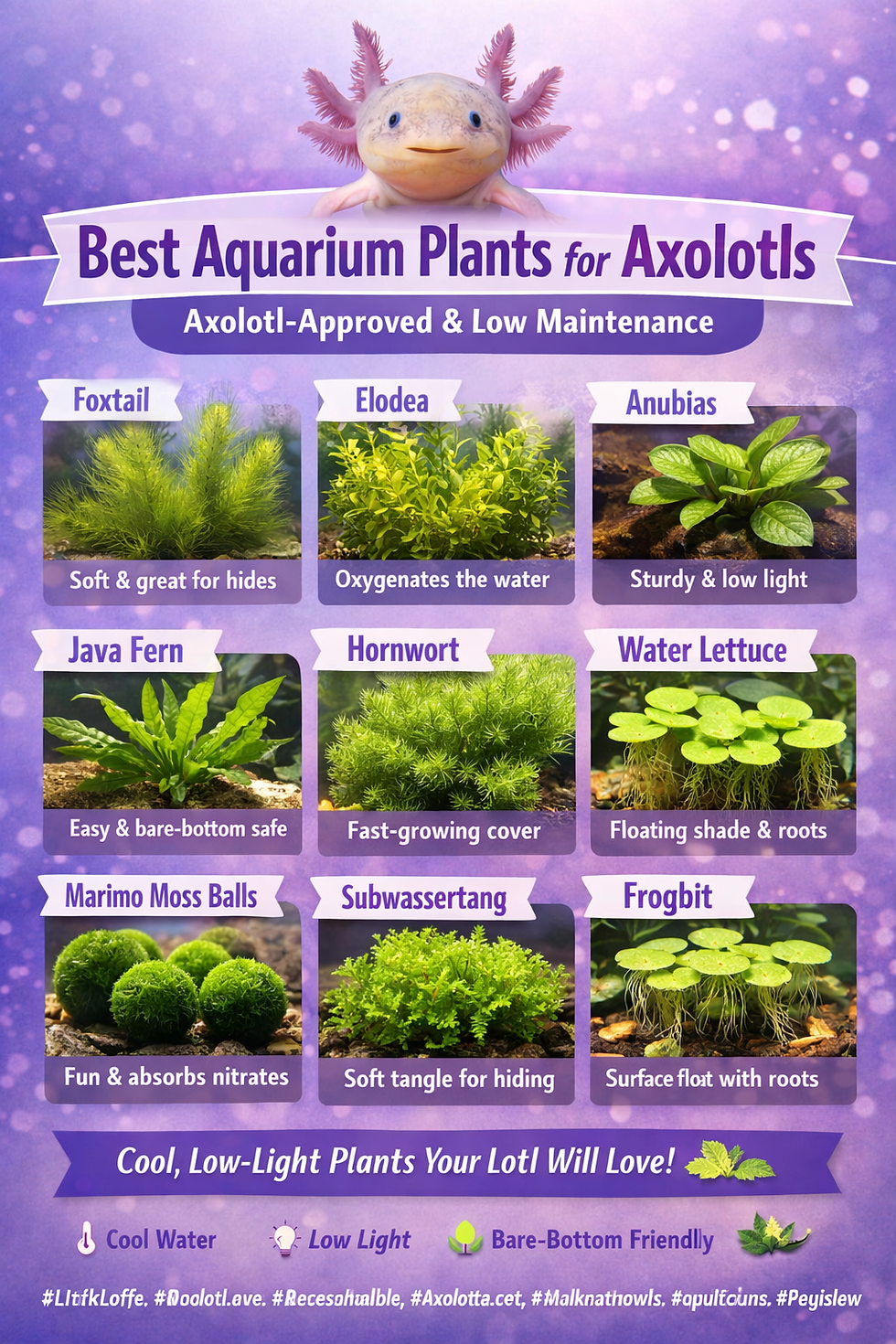
Its broad leaves can provide shaded resting areas, while its strong root system allows it to be securely attached to aquarium rocks, timber or decorations. Unlike many fast-growing aquarium plants, it does not require bright lighting, which is helpful because axolotls generally prefer dimmer aquarium environments.
The tough leaves are also less likely to be damaged when an axolotl walks over them or decides that the plant is the perfect place for an afternoon nap.
Anubias will not replace proper filtration or aquarium maintenance, but healthy live plants may use some nutrients from the water and can help create a more natural-looking environment.
Anubias Barteri Care Requirements
Anubias barteri is considered an undemanding aquarium plant. It can tolerate a wide range of aquarium conditions and usually grows successfully without specialised equipment.
Lighting
Low to moderate aquarium lighting is usually sufficient.
Because Anubias grows slowly, its leaves can become covered in algae when placed directly beneath intense lighting. Positioning it beneath taller plants, aquarium décor or shaded sections of the tank can help reduce algae growth.
Bright lighting will not necessarily make Anubias grow quickly. It may simply turn each leaf into premium waterfront real estate for algae.
For axolotl tanks, a low-intensity aquarium light operating for a controlled period each day is generally more suitable than strong planted-tank lighting.
Temperature
Anubias barteri can tolerate a broad temperature range, although its growth may slow considerably in cooler water.
This is not normally a problem in an axolotl aquarium. Axolotls require cool, stable water, and Anubias can continue surviving and producing new leaves under these conditions, although growth may be gradual.
Always prioritise the correct temperature for the axolotl rather than attempting to increase the temperature to accelerate plant growth.
Water Parameters
Anubias barteri is adaptable and can grow in both softer and harder aquarium water.
Stable water conditions are more important than chasing a perfect plant-specific pH. In an axolotl tank, water parameters should always be managed according to the animal’s needs.
A properly cycled axolotl aquarium should maintain:
Ammonia: 0 ppm
Nitrite: 0 ppm
Nitrate: controlled through regular water changes
A stable pH appropriate for axolotls
Cool, clean and dechlorinated water
Anubias may tolerate imperfect conditions, but it cannot make unsafe ammonia or nitrite harmless.
Carbon Dioxide
Injected carbon dioxide is not normally required.
Anubias barteri grows slowly under standard aquarium conditions and is suitable for low-technology planted tanks. Additional carbon dioxide may increase plant growth in specialised aquariums, but it is unnecessary for most axolotl setups.
How to Plant Anubias Barteri Correctly
Anubias barteri grows from a thick horizontal stem called a rhizome. The leaves grow upward from the rhizome, while thinner roots grow downward.
The rhizome must remain exposed to the water.
If the rhizome is buried beneath sand, gravel or aquarium soil, it may begin to rot. The individual roots can be positioned between rocks or lightly placed into the substrate, but the thick rhizome should remain above the surface.
Attach Anubias to a Rock
Attaching Anubias to a smooth aquarium-safe rock is one of the best options for an axolotl aquarium.
Place the rhizome against the rock and secure it using:
Cotton thread
Fishing line
A small amount of aquarium-safe cyanoacrylate gel glue
A plant weight positioned without crushing the rhizome
Over time, the roots will grip the rock naturally.
For axolotl tanks, choose rocks that are significantly larger than the axolotl’s head and do not have sharp edges.
Attach Anubias to Aquarium Timber
Anubias can also be attached to suitable aquarium timber.
Secure the rhizome gently against the timber until the roots establish themselves. Avoid timber with sharp branches, narrow gaps or rough points that could injure an axolotl.
Always make sure decorations are stable and cannot roll, collapse or trap the animal.
Position It Between Large Rocks
The roots may also be gently wedged between large, smooth aquarium rocks.
Do not crush the rhizome or place small loose stones in an axolotl aquarium. Axolotls may accidentally swallow objects that can fit inside their mouths.
Does Anubias Barteri Need Fertiliser?
Anubias receives much of its nutrition through the water column rather than relying entirely on its roots.
In a stocked aquarium, nutrients produced by normal waste may be sufficient for slow growth. A suitable liquid aquarium plant fertiliser may be used when needed, but any product added to an axolotl aquarium should be carefully checked for suitability and dosed conservatively.
Little Lotl's does not recommend using any fertiliser in an axolotl tank.
More fertiliser does not automatically produce faster growth. Excess nutrients combined with strong lighting may encourage algae instead.
If your Anubias appears healthy and continues producing occasional new leaves, additional fertiliser may not be necessary.
How Fast Does Anubias Barteri Grow?
Anubias barteri is a slow-growing aquarium plant.
It may produce only one new leaf every few weeks, particularly in a cool axolotl aquarium. This slow growth is normal and does not necessarily mean the plant is unhealthy.
Avoid repeatedly moving the plant in an attempt to make it grow faster. Once Anubias settles into a suitable position, consistency usually produces better results than constant rearranging.
How to Trim Anubias Barteri
Remove damaged, yellowing or heavily algae-covered leaves using clean aquarium scissors.
Cut the leaf stem close to the rhizome without cutting into the rhizome itself. Damaged leaves will not usually repair themselves, so removing them allows the plant to direct energy toward healthy growth.
Do not remove too many healthy leaves at once. Because Anubias grows slowly, heavy pruning can leave the plant with very little foliage for an extended period.
How to Propagate Anubias Barteri
Anubias barteri is propagated by dividing the rhizome.
Wait until the plant has developed a healthy, established rhizome with several leaves. Using clean, sharp scissors or a blade, cut the rhizome into sections.
Each section should ideally have:
Several healthy leaves
A portion of rhizome
Some established roots
Attach each new section to its own rock or piece of aquarium timber.
Small divisions may take time to begin growing, so patience is required. Anubias operates on botanical time, not express delivery.
Common Anubias Barteri Problems
Yellow Leaves
Yellow leaves may be caused by nutrient deficiencies, poor plant health, damage during transport or normal ageing of older leaves.
Remove severely damaged leaves and monitor new growth. New leaves provide a better indication of the plant’s current health than older leaves that may have developed under different growing conditions.
Rhizome Rot
A soft, dark or unpleasant-smelling rhizome may indicate rot.
This commonly occurs when the rhizome has been buried or when damaged plant tissue begins deteriorating.
Remove the plant, trim away rotten sections using a clean blade and reattach the healthy remaining rhizome above the substrate.
Algae on the Leaves
The slow-growing leaves of Anubias can attract algae, especially under strong lighting.
To reduce algae:
Lower the lighting intensity
Shorten the daily lighting period
Move the plant into partial shade
Maintain regular water changes
Avoid excessive fertiliser
Gently clean the leaves when necessary
Do not scrub the leaves aggressively, as this may damage the plant.
Leaves Melting After Planting
Some leaves may deteriorate after the plant is introduced to a new aquarium.
This can happen when a plant adjusts to different water conditions or when leaves grown above water adapt to being permanently submerged.
Remove leaves that become completely soft or decayed, but leave the healthy rhizome in place. New underwater-adapted leaves may gradually emerge.
No New Growth
Slow growth is normal for Anubias barteri.
Check that:
The rhizome is not buried
The plant is receiving some light
The rhizome is firm and healthy
The aquarium has stable water conditions
The leaves are not completely covered in algae
In a cool axolotl aquarium, growth may be particularly slow.
Can Anubias Barteri Be Planted in Sand?
The roots can extend into sand, but the rhizome must remain above the sand.
A safer and easier method is to attach the plant to a large rock and place the rock on top of the substrate. This keeps the rhizome exposed and makes the plant easy to move during tank cleaning.
Can Anubias Barteri Grow Without Substrate?
Yes.
Anubias does not need to be planted in aquarium soil, gravel or sand. It can grow while attached to aquarium-safe rocks, timber or decorations.
This makes it especially useful for bare-bottom axolotl tanks and aquariums using large river rocks.
Does Anubias Barteri Flower Underwater?
Healthy Anubias plants may occasionally produce a flower, even while submerged.
The flower resembles a small pale spike surrounded by a leaf-like structure. Flowering is interesting to observe, but it is not required for the plant to remain healthy.
Is Anubias Barteri Beginner Friendly?
Anubias barteri is one of the best live aquarium plants for beginners.
It offers:
Low lighting requirements
No requirement for injected carbon dioxide
Strong and durable leaves
Flexible placement options
Suitability for bare-bottom tanks
Slow and manageable growth
Natural shelter for aquarium animals
Its main care requirement is wonderfully simple: keep the rhizome exposed.
Final Thoughts
Anubias barteri is an attractive, hardy and low-maintenance plant that works particularly well in axolotl aquariums.
It tolerates low light, grows without specialised equipment and can be attached to rocks or aquarium timber rather than planted in substrate. Its broad leaves create natural cover, while its sturdy structure holds up well in an aquarium occupied by a curious axolotl.
Keep the water stable, avoid excessive lighting and never bury the rhizome. With those basics covered, Anubias barteri can remain a lush green feature in the aquarium for many years.
Looking for a hardy live plant for your axolotl aquarium?
Explore Little Lotl’s live aquarium plants and create a cooler, greener and more natural home for your axolotl.

Comments