


Why Are My Axolotl's Gills Shrinking?


A Deep Dive into Water Quality, Temperature, and Health
Few things worry axolotl owners more than noticing their pet's beautiful feathery gills looking smaller than they used to.
One day your axolotl has fluffy, bushy gills that look like underwater feathers.
The next, they seem thinner, shorter, or less vibrant.
Naturally, panic sets in.
Has your axolotl become sick?
Is something wrong with the tank?
Are the gills permanently damaged?
The good news is that shrinking gills are often a sign that something in the environment needs attention, and in many cases, improvements can lead to noticeable recovery.
Let's explore the most common causes of gill shrinkage and what you can do about it.
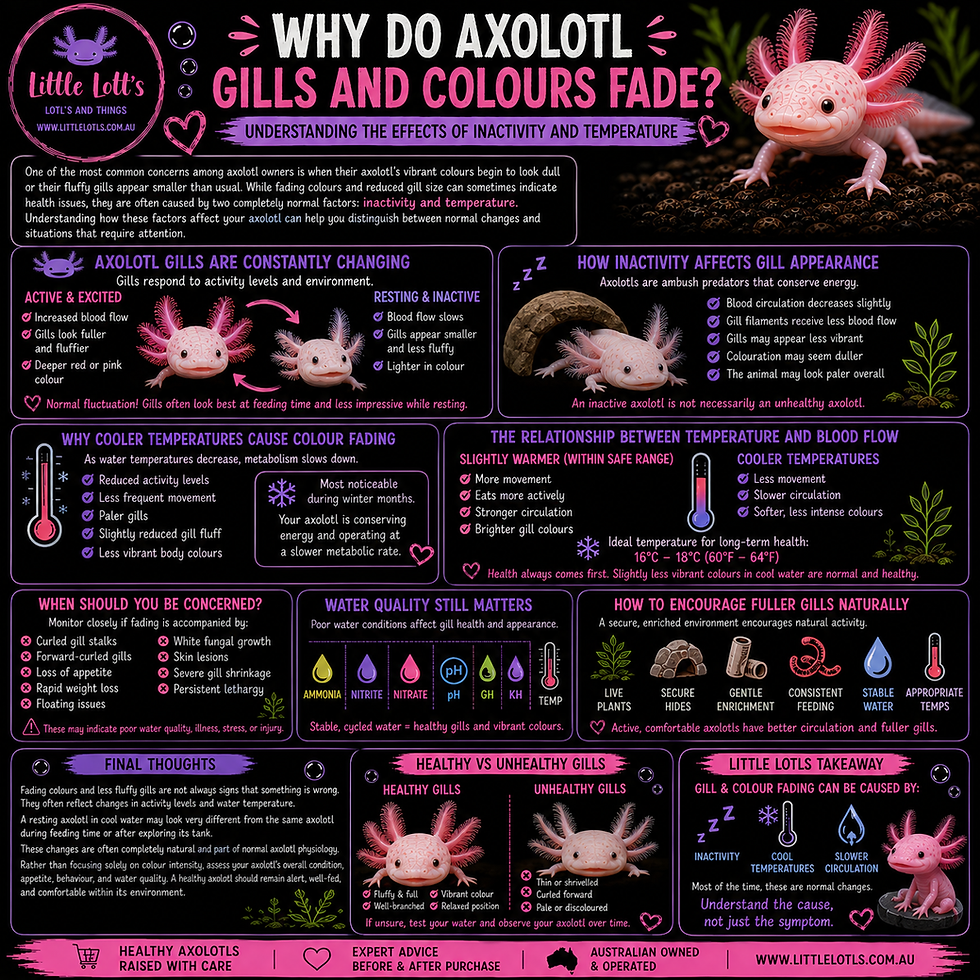
First: What Do Healthy Axolotl Gills Look Like?
Before we talk about problems, it's important to understand what healthy gills look like.
Healthy axolotl gills are usually:
✔ Fluffy and full
✔ Well-branched
✔ Evenly shaped
✔ Good colouration
✔ Held in a relaxed position
The tiny feathery filaments attached to each gill stalk are where oxygen exchange occurs.
The more developed these filaments are, the greater the surface area available for breathing.
Why Do Axolotls Have Feathery Gills?
Unlike most salamanders, axolotls retain their external gills throughout their lives.
These gills help them absorb oxygen directly from the water.
Because the filaments are so delicate, they often respond quickly to changes in the environment.
Think of them as an early warning system.
When something isn't quite right, the gills are often one of the first places you'll notice it.
Cause #1: Poor Water Quality
The most common reason for shrinking gills is poor water quality.
Axolotls are extremely sensitive to toxic compounds such as:
Ammonia
Nitrite
Excessive nitrate
Even low levels of ammonia and nitrite can stress an axolotl and damage delicate gill tissue over time.
Ideal Water Parameters
✔ Ammonia: 0 ppm
✔ Nitrite: 0 ppm
✔ Nitrate: Below 20 ppm
Regular testing is essential because water can appear crystal clear while still containing harmful compounds.
Cause #2: High Water Temperatures
Temperature has a huge impact on axolotl health.
Warm water holds less dissolved oxygen than cool water.
This means your axolotl must work harder to breathe.
Over time, prolonged exposure to elevated temperatures can contribute to:
Stress
Reduced appetite
Gill deterioration
Increased disease risk
Ideal Temperature Range
14°C to 18°C
While occasional fluctuations happen, temperatures consistently above 22°C can cause significant problems.
Cause #3: Low Oxygen Levels
Since gills are used for oxygen exchange, low oxygen environments can affect their appearance.
Common causes include:
Poor water movement
Overcrowding
High temperatures
Excess waste buildup
You may notice your axolotl frequently swimming to the surface for air.
Solution
Improve oxygenation by using:
Air stones
Sponge filters
Gentle surface agitation
More oxygen often means healthier gills.
Cause #4: Excessive Water Flow
This one surprises many new owners.
Axolotls prefer calm water.
Strong currents can cause chronic stress.
Signs include:
Forward-curled gills
Constant swimming
Difficulty resting
Reduced appetite
If your filter output resembles a miniature river rapids, your axolotl may not be impressed.
Solution
Reduce flow using:
Spray bars
Filter baffles
Sponge pre-filters
Your axolotl should be able to rest comfortably without being pushed around the tank.
Cause #5: Long-Term Stress
Stress affects almost every aspect of axolotl health.
Potential stressors include:
Bright lighting
Frequent handling
Aggressive tank mates
Poor water quality
Inadequate hiding places
Over time, chronic stress can contribute to thinning gill filaments.
Solution
Provide a calm, stable environment with plenty of hides and consistent conditions.
Cause #6: Natural Genetics
Not all axolotls have giant fluffy gills.
Some naturally develop:
Large bushy gills
Medium gills
Smaller, finer gills
Genetics play a significant role.
Comparing your axolotl to photos online can sometimes create unnecessary worry.
The important question is:
Has there been a noticeable change from your axolotl's normal appearance?
Cause #7: Illness or Injury
Infections and health problems can affect gill appearance.
Watch for additional symptoms such as:
Fungus
Lethargy
Weight loss
Loss of appetite
Skin abnormalities
If shrinking gills occur alongside other symptoms, investigate further and seek veterinary advice if necessary.
Can Shrinking Gills Recover?
In many cases, yes.
One of the remarkable things about axolotls is their ability to recover when conditions improve.
Once the underlying cause is addressed, owners often notice:
✔ Improved gill colour
✔ Fuller filaments
✔ Better appetite
✔ Increased activity
Recovery may take weeks or even months, so patience is important.
What About Gill Colour?
Gill colour can also provide clues.
Bright Pink or Red Gills
Often indicate strong blood flow and oxygen exchange.
Pale Gills
May suggest:
Stress
Poor circulation
Poor water quality
However, colour varies naturally between morphs and individuals.
Always assess the whole axolotl rather than focusing on a single feature.
How to Keep Gills Looking Their Best
Healthy gills start with healthy husbandry.
Checklist for Healthy Gills
✔ Maintain 0 ppm ammonia
✔ Maintain 0 ppm nitrite
✔ Keep nitrate low
✔ Keep temperatures between 14°C and 18°C
✔ Ensure adequate oxygenation
✔ Avoid strong currents
✔ Feed a nutritious diet
✔ Perform regular water changes
✔ Provide a stress-free environment
The Gill Report Card
If there is one thing every axolotl owner should learn, it's this:
Your axolotl's gills are constantly providing information about its environment.
Healthy gills often mean:
Good water quality
Proper oxygen levels
Appropriate temperatures
Low stress
When the gills start changing, they're usually trying to tell you something.
The sooner you listen, the easier it is to correct the problem.
Little Lotls Takeaway
Shrinking gills are not a disease themselves.
They are usually a symptom of an underlying issue such as:
Poor water quality
High temperatures
Low oxygen
Excessive flow
Stress
Illness
Fortunately, most causes can be identified and corrected with good aquarium maintenance and regular water testing.
And remember, healthy gills aren't just beautiful.
They're one of the best indicators of your axolotl's overall health.
So the next time you admire those feathery underwater plumes, remember they're doing far more than making your axolotl look adorable.
They're telling the story of the entire aquarium.


Comments