


Common Beginner Axolotl Mistakes and How to Avoid Them

Updated: Jul 23

Bringing home an axolotl is exciting, but a few common beginner mistakes can quickly lead to poor water quality, stress and preventable health problems.
The good news is that most axolotl care mistakes are easy to avoid once you understand what these sensitive aquatic amphibians need.
Axolotls rely completely on their environment. They cannot leave warm, toxic or unsuitable water, so correct tank preparation, regular testing and stable routines are essential.
This beginner-friendly guide explains the most common axolotl care mistakes, why they matter and how to create a safer, healthier home for your lotl.
Why Beginner Axolotl Mistakes Matter
Axolotls may look calm and sturdy, but their skin, gills and overall health are closely connected to the water around them.
Small care errors can result in:
Ammonia or nitrite exposure
Heat stress
Curled or forward-facing gills
Loss of appetite
Lethargy
Floating
Skin irritation
Impaction
Fungal growth
Long-term health problems
Successful axolotl care is not about making the aquarium complicated.
It is about keeping the setup cool, clean, cycled, safe and stable.
1. Buying an Axolotl Before the Tank Is Cycled
Adding an axolotl to an uncycled aquarium is one of the most serious beginner mistakes.
A new tank is not safe simply because the water looks clean.
Before an axolotl can live in the aquarium, beneficial bacteria must become established.
These bacteria process toxic waste through the nitrogen cycle:
Axolotl waste and uneaten food produce ammonia.
Beneficial bacteria convert ammonia into nitrite.
Another group of bacteria converts nitrite into nitrate.
Nitrate is controlled through water changes and maintenance.
A fully cycled axolotl tank should consistently test:
Ammonia: 0 ppm
Nitrite: 0 ppm
Nitrate: Present but less than 20 ppm
How to avoid this mistake
Cycle the aquarium before purchasing the axolotl
Use a reliable liquid test kit
Provide an ammonia source during fishless cycling
Test ammonia, nitrite, nitrate, pH, GH and KH
Wait until the tank processes waste consistently
Cycling may take several weeks.
Patience now is considerably easier than an ammonia emergency later.
2. Keeping the Water Too Warm
Axolotls are cold-water animals.
Many new keepers accidentally use tropical aquarium temperatures or assume ordinary room temperature will always be suitable.
Little Lotl’s recommended temperature range is:
14°C to 18°C
Temperatures above 20°C can increase stress, reduce oxygen availability and raise the risk of illness.
This is especially important for Australian axolotl keepers during summer.
Signs the water may be too warm
Reduced appetite
Restlessness
Lethargy
Curled gills
Increased surface gulping
Poor gill condition
Unusual behaviour
How to avoid this mistake
Use a reliable aquarium thermometer
Keep the tank away from direct sunlight
Avoid placing the aquarium near windows
Use aquarium cooling fans where suitable
Install a chiller if required
Prepare a summer cooling plan before hot weather arrives
A thermometer is cheaper than guessing, and far less dramatic.
3. Using Gravel or Swallowable Substrate
Axolotls feed by rapidly sucking food into their mouths.
If gravel, pebbles or other loose pieces are nearby, they may swallow them accidentally.
This can cause impaction, digestive problems and serious health complications.
Safer substrate options
Bare-bottom aquarium
Very fine aquarium-safe sand for appropriately sized axolotls
Large smooth rocks much bigger than the axolotl’s head
Potted plants
Plants attached to aquarium décor
Avoid
Gravel
Small pebbles
Coarse sand
Sharp stones
Aquasoil in standard axolotl tanks
Decorative pieces small enough to swallow
Bare-bottom tanks are especially useful for juveniles, rescues, quarantine tanks and easy cleaning.
4. Using a Filter With Excessive Flow
Axolotls produce plenty of waste, so they need effective biological filtration.
However, they do not enjoy strong current.
A powerful filter can make it difficult for an axolotl to rest and may cause ongoing stress.
Signs the flow may be too strong
Being pushed around the tank
Avoiding the filter side
Difficulty resting
Constantly curved or forward-facing gills
Persistent restlessness
Tail curling
How to reduce filter flow
Use a spray bar
Point the outlet toward the aquarium glass
Add an aquarium-safe sponge to soften the outlet
Adjust the filter setting
Use décor to disperse the current
The goal is strong filtration without creating an underwater leaf blower.
5. Not Testing the Water Regularly
Dangerous aquarium conditions are often invisible.
Clear water may still contain ammonia, nitrite, high nitrate, unstable pH or unsuitable mineral levels.
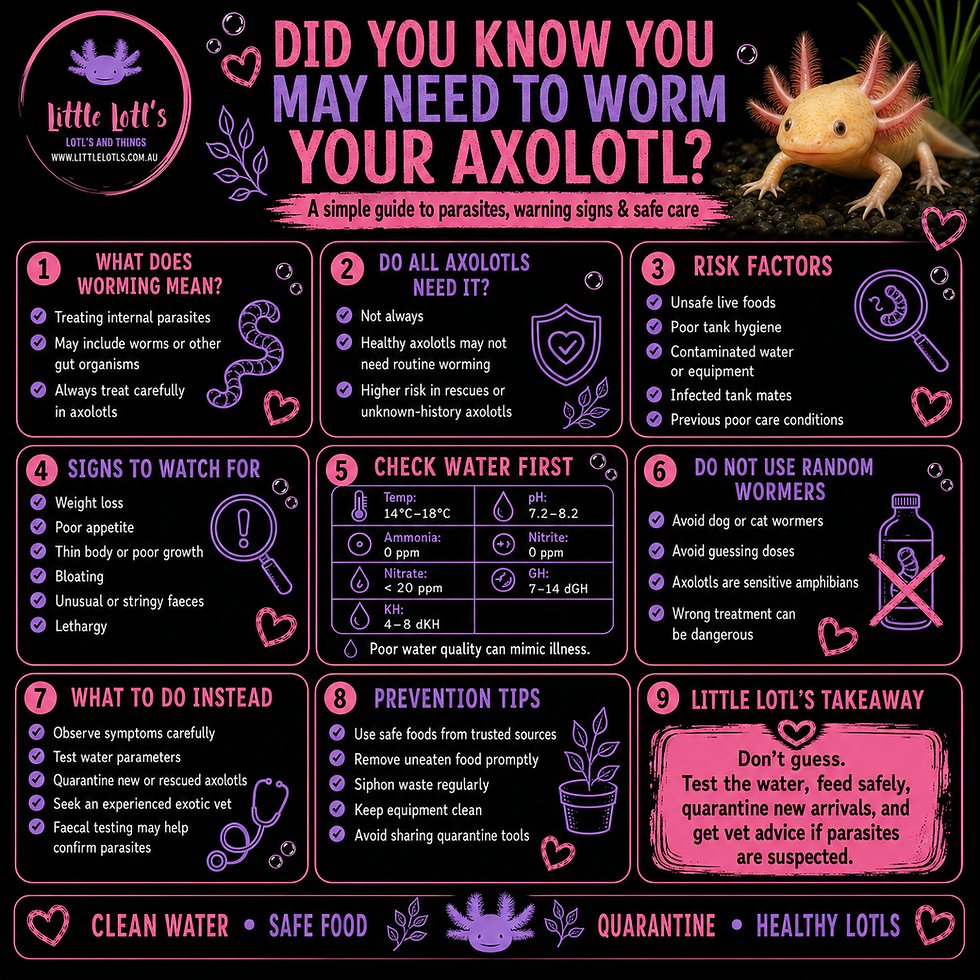
Little Lotl’s recommended axolotl water parameters are:
Temperature: 14°C to 18°C
pH: 7.2 to 8.2
Ammonia: 0 ppm
Nitrite: 0 ppm
Nitrate: Less than 20 ppm
GH: 7 to 14 dGH
KH: 4 to 8 dKH
How often should you test?
For established tanks, weekly testing is a sensible routine.
Test more frequently when:
The tank is cycling
The aquarium is newly occupied
Your axolotl appears unwell
You change water sources
You move house
You upgrade the tank
The filter stops working
You replace filter media
The temperature becomes unstable
A reliable liquid test kit is one of the most important tools an axolotl keeper can own.
6. Overfeeding
Axolotls are enthusiastic eaters, which can make overfeeding surprisingly easy.
Too much food creates excess waste and may contribute to:
Ammonia spikes
High nitrate
Dirty substrate
Cloudy water
Weight gain
Poor aquarium stability
How to avoid overfeeding
Feed according to age, size and body condition
Offer appropriate portions
Remove leftovers promptly
Avoid repeatedly offering food after the axolotl is full
Monitor body shape over time
Adult axolotls generally eat less frequently than juveniles.
A hungry-looking axolotl may simply be performing its award-winning impression of an animal that has never encountered food.
7. Leaving Uneaten Food in the Tank
Even an appropriate meal can cause water problems if the leftovers remain in the aquarium.
Food can become trapped:
Behind hides
Under plants
In sand
Around filter intakes
In tank corners
As it breaks down, it produces ammonia.
How to avoid this mistake
Feed in a consistent area
Use feeding tongs or a dish where appropriate
Inspect the tank after feeding
Remove uneaten food promptly
Siphon hidden debris during maintenance
The missing pellet is rarely gone.
It is usually hiding somewhere, plotting against the nitrogen cycle.
8. Feeding an Inappropriate Diet
Axolotls are carnivorous and need suitable animal-based foods.
Good staple foods may include:
Earthworms
Nightcrawlers
Quality axolotl pellets
Blackworms for smaller axolotls
Other appropriately sourced foods
Foods to avoid or use cautiously
Unquarantined feeder fish
Wild-caught insects
Wild-caught worms from unsafe areas
Red meat
Chicken
Processed human food
Food that is too large to swallow
Bloodworms as the main long-term diet for adults
Earthworms are one of the best staple foods for many juvenile and adult axolotls.
Food size should always be suitable for the axolotl.
9. Handling the Axolotl Too Often
Axolotls are display pets.
They have delicate skin and a protective slime coat that can be damaged by unnecessary handling.
Handling may also cause significant stress.
How to move an axolotl safely
Use a clean container where possible
Keep the animal submerged
Move slowly and calmly
Support the entire body
Avoid chasing it around the tank
Never lift it by the gills, legs or tail
Handling should be limited to necessary transfers, health checks or emergencies.
Admiring through the glass is the luxury seating option.
10. Using Sharp or Unsafe Decorations
Axolotls have soft skin, delicate toes and exposed gills.
Rough or sharp décor can cause cuts, abrasions and gill damage.
Avoid
Sharp plastic plants
Jagged rocks
Rough cave entrances
Narrow gaps
Unstable decorations
Small decorative pieces
Exposed wire or metal
Choose instead
Smooth aquarium caves
PVC pipe hides
Ceramic hides
Sanded terracotta pots
Soft live plants
Secure aquarium-safe décor
Inspect every item by touch before placing it in the tank.
If it feels sharp to your hand, it may be dangerous to an axolotl.
11. Keeping Axolotls With Unsuitable Tank Mates
Axolotls do not need fish or other animals for companionship.
Many tank mates create risks.
Fish may:
Nip external gills
Carry parasites
Introduce disease
Compete for food
Be swallowed
Shrimp and snails may also create ingestion, injury or disease concerns depending on the species and setup.
How to avoid this mistake
Keep the aquarium axolotl-focused
Avoid impulse tank-mate additions
Quarantine all new animals
Research compatibility carefully
Remember that axolotls can live happily alone
A quiet tank is not a lonely tank.
12. Keeping Axolotls of Very Different Sizes Together
Axolotls may accidentally bite limbs, tails or gills, particularly during feeding.
Housing animals of very different sizes increases the risk of injury.
Safer group housing requires
Similar-sized axolotls
Adequate tank space
Multiple hides
Careful feeding
Close observation
Separation if biting occurs
Young axolotls are especially prone to accidental nipping.
They are not malicious. Their food detection simply contains more confidence than accuracy.
13. Ignoring Early Signs of Stress
Small behavioural changes may be the first sign that something is wrong.
Possible warning signs include:
Curled or forward-facing gills
Loss of appetite
Floating
Lethargy
Pale or irritated skin
Unusual posture
Repeated frantic swimming
Hiding more than usual
Poor gill condition
Sudden changes in behaviour
These signs can have several causes, but water quality should always be checked first.
Test:
Temperature
Ammonia
Nitrite
Nitrate
pH
GH
KH
Do not diagnose from appearance alone.
Let the water test results join the conversation.
14. Washing Filter Media in Tap Water
Beneficial bacteria live mainly inside the filter media.
Untreated tap water may contain chlorine or chloramine, which can damage or kill those bacteria.
This can cause ammonia and nitrite to appear and may trigger a cycle crash.
Correct filter care
Keep the filter running continuously
Rinse media only when needed
Use old tank water for rinsing
Do not scrub media spotless
Never replace all media at once
Keep media wet during tank moves
Filter media is not meant to be pristine.
It is a tiny bacterial suburb doing essential unpaid labour.
15. Replacing All Filter Media at Once
Disposable cartridges are often marketed for frequent replacement, but replacing all biological media can remove a large part of the bacterial colony.
Better approach
Replace media only when damaged or unusable
Keep old and new media together temporarily
Change one section at a time
Preserve biological media wherever possible
Test ammonia and nitrite after changes
Protecting the cycle is more important than making the filter look brand new.
16. Deep-Cleaning the Entire Aquarium
Overcleaning can remove beneficial bacteria and destabilise the tank.
Problems may occur when keepers clean:
The filter
All decorations
The substrate
The glass
The plants
The entire water volume
all on the same day.
How to avoid this mistake
Perform partial water changes
Clean sections gradually
Preserve filter media
Avoid sterilising the tank
Remove waste without stripping the entire ecosystem
A healthy aquarium is a living system, not an operating theatre.
17. Forgetting Water Conditioner
Tap water should always be treated before entering an axolotl tank.
Chlorine and chloramine can harm:
Axolotls
Their gills
Their skin
Beneficial bacteria
Use conditioner for:
Water changes
Top-ups
Temporary tubs
Quarantine containers
Emergency water
Never assume leaving tap water to stand will remove chloramine.
Treat every new batch properly.
18. Making Sudden Water Chemistry Changes
Axolotls and beneficial bacteria both prefer stability.
Rapid adjustments to pH, GH, KH or temperature may cause more harm than a stable reading that is slightly imperfect.
Safer approach
Make changes slowly
Test before adjusting
Retest after changes
Avoid mixing multiple products without understanding them
Match replacement water temperature closely
Focus on stable ranges rather than chasing one exact number
Aquarium chemistry is not improved by enthusiastic button-mashing.
19. Skipping Regular Water Changes
Even a cycled tank needs maintenance.
Nitrate and dissolved waste accumulate over time.
Most established axolotl tanks benefit from regular partial water changes based on test results and waste levels.
A common routine may include:
Testing the water weekly
Changing approximately 20% to 30% when appropriate
Using conditioned water
Matching temperature closely
Siphoning waste
Keeping nitrate below 20 ppm
The water test results should guide your routine.
20. Assuming Axolotls Are Low-Maintenance Pets
Axolotls can have a simple routine once the aquarium is stable, but they still require consistent care.
They need:
Water testing
Temperature monitoring
Feeding
Waste removal
Water changes
Filter maintenance
Health observation
A summer cooling plan
Long-term commitment
Axolotls may live for approximately 10 to 15 years with good care.
They are not temporary decorations with fluffy gills.
Little Lotl’s Beginner Axolotl Checklist
Before bringing an axolotl home, make sure you have:
A tank of approximately 120 litres or larger
A completed nitrogen cycle
Ammonia at 0 ppm
Nitrite at 0 ppm
Nitrate below 20 ppm
Temperature between 14°C and 18°C
pH between 7.2 and 8.2
GH between 7 and 14 dGH
KH between 4 and 8 dKH
Strong biological filtration
Gentle water flow
Safe substrate
Secure hides
Water conditioner
A liquid test kit
Suitable food
A reliable cooling plan
Frequently Asked Questions
What is the biggest beginner axolotl mistake?
Adding an axolotl to an uncycled aquarium is one of the most dangerous mistakes. Ammonia and nitrite can quickly rise and damage the animal’s gills, skin and overall health.
Is gravel safe for axolotls?
No. Gravel and small pebbles may be swallowed and can cause impaction. Bare bottom or very fine aquarium-safe sand are safer options in suitable setups.
How often should axolotl water be tested?
Established tanks should generally be tested weekly. New, cycling or unstable tanks should be tested more frequently.
What temperature is too warm for an axolotl?
Temperatures above 20°C can become stressful. Little Lotl’s recommends maintaining 14°C to 18°C.
Can axolotls live with fish?
Most fish are not recommended because they may nip the axolotl’s gills, carry disease, compete for food or be swallowed.
Should filter media be replaced every month?
Not necessarily. Biological media should be preserved and replaced only when it is damaged or no longer usable. Never replace all filter media at once.
Can I hold my axolotl?
Axolotls should only be handled when necessary. A clean container is generally safer for transfers.
What should I test first if my axolotl looks stressed?
Check temperature, ammonia, nitrite, nitrate, pH, GH and KH. Water quality is one of the most common causes of stress.
Final Thoughts
Most beginner axolotl mistakes happen because new keepers are trying to do the right thing without yet understanding how strongly water quality and stability affect these animals.
The best foundations are simple:
Cycle the tank before purchase
Keep water between 14°C and 18°C
Maintain 0 ppm ammonia
Maintain 0 ppm nitrite
Keep nitrate below 20 ppm
Use safe substrate
Provide gentle filtration
Feed suitable foods
Test regularly
Avoid unnecessary handling
Make changes slowly
You do not need a complicated aquarium to keep an axolotl healthy.
You need a prepared tank, stable water and a routine that quietly does its job.
Clean water, cool temperatures and good habits prevent most beginner problems before they have a chance to grow teeth.


Comments