


Ideal Water Parameters for Axolotls: A Complete Beginner Guide

When it comes to keeping axolotls healthy, water quality is everything.
Axolotls live fully aquatic lives, which means their water is not just their home. It is their air, their comfort zone, their bathroom, their dining room, and their little underwater universe.
Because of this, getting the water parameters right is one of the most important parts of axolotl care.
This guide explains the ideal water parameters for axolotls, what each reading means, why it matters, and how to keep your aquarium stable.
Why Water Parameters Matter for Axolotls
Axolotls have delicate skin and external gills. They absorb substances from the water around them, so poor water quality can quickly affect their health.
Incorrect water parameters may lead to:
Curled gills
Loss of appetite
Stress
Floating
Skin irritation
Poor gill condition
Lethargy
Increased risk of illness
Cycle crashes
Sudden water quality problems
The goal is not just “clean-looking water.”
Clear water can still contain ammonia, nitrite, or unsafe chemistry.
A healthy axolotl tank needs water that is tested, stable, cool, and properly cycled.
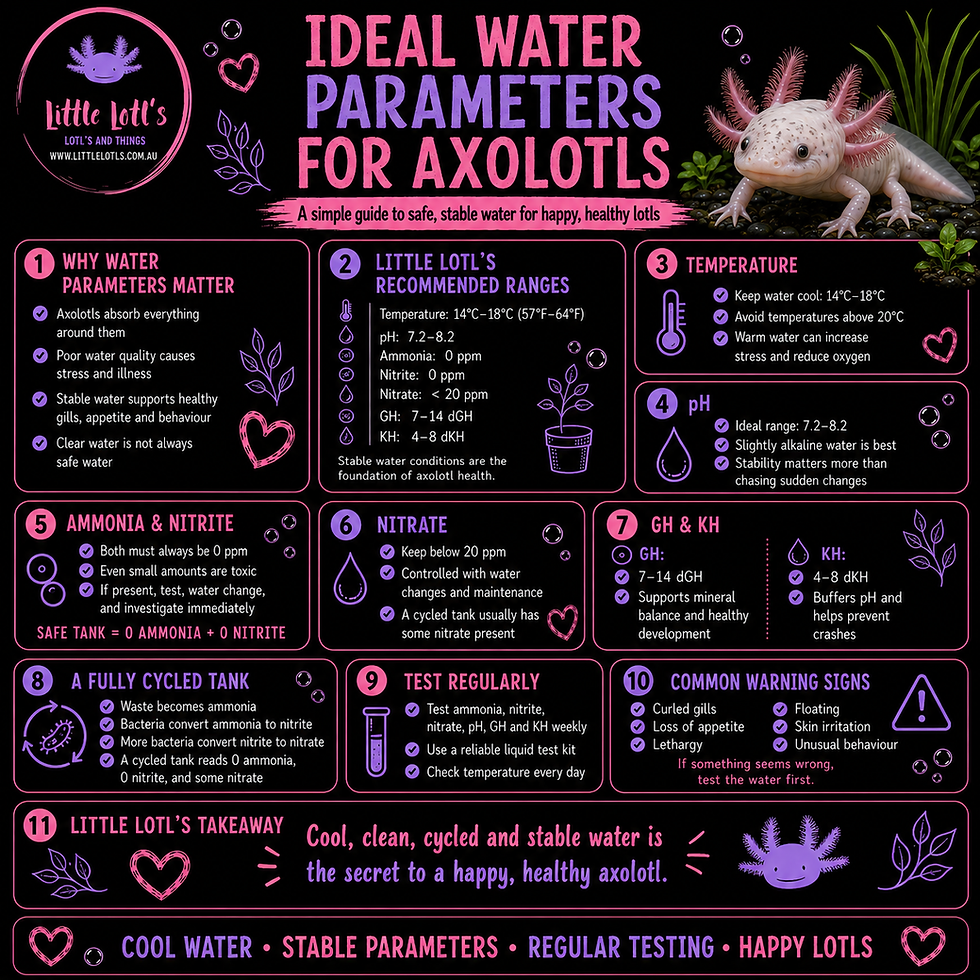
Little Lotl’s Recommended Axolotl Water Parameters
For healthy axolotls, Little Lotl’s recommends:
Temperature: 14°C to 18°C (57°F to 64°F)
pH: 7.2 to 8.2
Ammonia: 0 ppm
Nitrite: 0 ppm
Nitrate: Less than 20 ppm
GH: 7 to 14 dGH
KH: 4 to 8 dKH
These ranges support healthy gills, stable water chemistry, good biological filtration, and a comfortable environment for your axolotl.
Axolotls are cold-water animals.
The ideal temperature range is:
14°C to 18°C
This cool range helps keep axolotls comfortable, supports oxygen levels, and reduces stress.
Water that is too warm can cause serious problems.
High temperatures may lead to:
Stress
Faster waste buildup
Reduced oxygen levels
Increased risk of fungal or bacterial issues
Loss of appetite
Lethargy
Poor gill condition
Temperatures above 20°C should be avoided.
If your tank regularly gets too warm, consider cooling methods such as:
Aquarium fans
A chiller
Cooler room placement
Avoiding direct sunlight
Keeping lights limited
Using frozen bottles carefully in emergencies only
Do not cause sudden temperature swings. Cool, stable water is the aim.
pH tells you whether the water is acidic, neutral, or alkaline.
Axolotls generally prefer slightly alkaline water.
Little Lotl’s recommended pH range is:
7.2 to 8.2
Stable pH helps support:
Healthy gills
Beneficial bacteria
Comfortable water conditions
A stable nitrogen cycle
A pH that changes suddenly can be more stressful than a stable reading that is slightly outside the ideal range.
If your pH keeps dropping, check KH. Low KH is one of the most common causes of unstable pH.
Ammonia is highly toxic and should always be:
0 ppm
Ammonia comes from:
Axolotl waste
Uneaten food
Decaying plants
Rotting organic matter
Uncycled tanks
Filter problems
Even small amounts can irritate gills, skin, and eyes.
Signs of ammonia stress may include:
Curled gills
Loss of appetite
Lethargy
Red or irritated skin
Floating
Excess slime coat
Sudden unusual behaviour
If ammonia is present, act quickly. Test the water, remove waste, perform a water change, check the filter, and tub your axolotl if the tank becomes unsafe.
Nitrite is also toxic and should always be:
0 ppm
Nitrite appears during the nitrogen cycle when beneficial bacteria convert ammonia into nitrite.
A second group of bacteria then converts nitrite into nitrate.
Nitrite can affect oxygen exchange and cause stress.
Signs of nitrite stress may include:
Curled or forward-facing gills
Reduced appetite
Lethargy
Floating
Restlessness
Hiding
Pale or dull gills
Unusual behaviour
If nitrite is present, the tank is not safe for an axolotl.
A cycled tank should always show 0 ppm ammonia and 0 ppm nitrite.
Nitrate is the final stage of the nitrogen cycle.
It is much less toxic than ammonia or nitrite, but it still needs to be kept under control.
Little Lotl’s recommended nitrate level is:
Less than 20 ppm
Nitrate builds up from:
Processed waste
Uneaten food
Decaying organic matter
Normal biological filtration
High nitrate may contribute to:
Stress
Poor gill condition
Reduced appetite
Algae growth
Lower water quality
Nitrate is mainly controlled through:
Regular water changes
Siphoning waste
Removing uneaten food
Avoiding overfeeding
Live plants
Good maintenance routines
A cycled tank usually has some nitrate present, but it should stay low.
GH stands for general hardness.
It measures dissolved minerals in the water, mainly calcium and magnesium.
Little Lotl’s recommended GH range is:
7 to 14 dGH
GH helps support:
Healthy gills
Growth and development
Skin condition
Mineral balance
Strong body structure
Long-term wellbeing
Water that is too soft may not provide enough minerals.
Water that is extremely hard may become uncomfortable or difficult to manage.
GH should be adjusted slowly if needed.
KH stands for carbonate hardness.
It measures the water’s buffering capacity, which means how well the water resists pH changes.
Little Lotl’s recommended KH range is:
4 to 8 dKH
KH helps:
Keep pH stable
Prevent pH crashes
Support beneficial bacteria
Maintain the nitrogen cycle
Create safer long-term water conditions
If KH is too low, pH may drop suddenly.
If your tank keeps having pH problems, KH is one of the first things to test.
A safe axolotl tank must be cycled.
The nitrogen cycle works like this:
Axolotl waste and uneaten food produce ammonia.
Beneficial bacteria convert ammonia into nitrite.
More beneficial bacteria convert nitrite into nitrate.
Nitrate is removed through water changes, plants, and maintenance.
A fully cycled tank should test:
Ammonia: 0 ppmNitrite: 0 ppmNitrate: Present but less than 20 ppm
Never add an axolotl to an uncycled tank unless you are prepared to tub safely and manage the tank separately.
A clear tank is not automatically a cycled tank.
The test kit tells the truth.
Testing is one of the best habits an axolotl keeper can build.
Test more often when:
Cycling a new tank
Moving house
Upgrading a tank
Changing filters
Your axolotl seems unwell
You notice appetite changes
The tank smells unusual
Water becomes cloudy
You have had a temperature spike
For an established tank, weekly testing is a good routine.
Test:
Ammonia
Nitrite
Nitrate
pH
GH
KH
Temperature
A liquid test kit is usually more reliable than test strips.
Signs Your Water Parameters May Be Wrong
Your axolotl may show signs of stress if the water is unsafe or unstable.
Watch for:
Curled gills
Forward-facing gills
Pale gills
Loss of appetite
Lethargy
Floating
Restlessness
Hiding more than usual
Skin irritation
Excess slime coat
Sudden darting
Unusual posture
Poor gill condition
These signs do not always point to one specific parameter.
If something seems wrong, test everything.
Water quality is the detective hat of axolotl keeping.
Common Water Parameter Mistakes
Avoid these common mistakes:
Adding axolotls to uncycled tanks
Not testing ammonia and nitrite
Assuming clear water is safe
Letting nitrate climb too high
Chasing pH with quick-fix products
Ignoring KH
Ignoring GH
Allowing temperature to rise above safe levels
Rinsing filter media in tap water
Replacing all filter media at once
Overfeeding
Skipping water changes
Forgetting water conditioner
Most water problems are easier to prevent than fix.
What To Do If Parameters Are Unsafe
If your water test results are unsafe, act calmly and quickly.
If Ammonia or Nitrite Is Present
Test again to confirm
Perform a partial water change
Remove uneaten food and waste
Check the filter is running properly
Make sure biological media has not dried out or been washed in tap water
Tub your axolotl if the tank is unsafe
Continue testing daily until stable
If Nitrate Is Too High
Perform a partial water change
Siphon waste
Remove dead plant matter
Review feeding
Test your tap water
Improve your maintenance routine
If pH Is Unstable
Test KH
Check source water
Avoid sudden adjustments
Adjust slowly if needed
If GH or KH Is Outside Range
Test source water
Adjust gradually
Use axolotl-safe products only
Avoid sudden swings
Retest after changes
Slow and steady wins the lotl race.
How to Keep Water Parameters Stable
To maintain ideal water conditions:
Fully cycle the tank
Use a suitable filter
Keep filter media alive and wet
Feed appropriately
Remove uneaten food
Siphon waste regularly
Do weekly water changes
Test water consistently
Keep the tank cool
Avoid overcrowding
Use dechlorinated water
Avoid sudden changes
Stable water is built from small repeated habits.
Little Lotl’s Water Parameter Checklist
For happy, healthy axolotls, aim for:
Temperature: 14°C to 18°C
pH: 7.2 to 8.2
Ammonia: 0 ppm
Nitrite: 0 ppm
Nitrate: Less than 20 ppm
GH: 7 to 14 dGH
KH: 4 to 8 dKH
Fully cycled tank
Regular testing
Consistent maintenance
Cool, clean, stable water
Final Thoughts
Ideal water parameters are the foundation of axolotl care.
When your water is cool, clean, cycled, and stable, your axolotl has the best chance of staying healthy, eating well, growing properly, and showing relaxed natural behaviour.
The most important readings to remember are:
Temperature: 14°C to 18°CpH: 7.2 to 8.2 Ammonia: 0 ppm Nitrite: 0 ppm Nitrate: Less than 20 ppm GH: 7 to 14 dGH KH: 4 to 8 dKH
Good axolotl care is not about guessing.
It is about testing, observing, and keeping the water stable.
Clean water, cool temperatures, and consistent care are the secret ingredients for a happy, healthy lotl.


Comments